Jeremy Singer, Sarah Winchell Lenhoff, Jerome Graham, and Richard O. Welsh
Chronic absenteeism is a top concern for district leaders, but what schools are actually doing about it is unclear.
Since the pandemic, chronic absenteeism (missing 10% or more of school days) has surged nationally and remains stubbornly high. The consequences are well documented: students who miss too much school are less likely to read on grade level, less likely to graduate, and less likely to enroll in college. Roughly 40% of district leaders nationwide now identify attendance as one of their top challenges.
But for all the attention paid to chronic absenteeism, we know surprisingly little about what schools are actually doing to fix it. Most existing research has either evaluated a single intervention in a single district or offered guidance about what schools could do. The field has lacked a systematic look at what schools have actually adopted, how those choices vary across contexts, and whether the strategies in widest use are the ones research suggests will work.
Why this matters for policy.
Not all attendance strategies are created equal. Some (like phone calls and text message reminders) are cheap and easy to implement but have modest effects at best. Others (like arranging transportation) directly address the root causes of absenteeism but require staffing, funding, and cross-sector collaboration that many schools do not have. A third category of attendance strategies, focused on improving the experience students have in school itself (like relationships with teachers), sits in between: well-supported by research as a driver of attendance, but harder to tie directly to attendance metrics.
If schools are over-investing in low-impact strategies and under-investing in higher-impact ones, the field needs to know. And if state policy is shaping those choices, policymakers need to know which levers actually move practice.
STUDY AND METHODS
This study draws on a survey of K-12 public school principals in Michigan and Georgia at the end of the 2024-25 school year. The researchers received 1,524 responses (1,143 in Michigan and 376 in Georgia).
Michigan and Georgia are a useful pair: they are similar in population size but differ meaningfully in geography, demographics, school system structure, and state policy. Georgia recently passed legislation (SB 123) that requires districts to establish attendance review teams and prohibits expulsion for absenteeism alone. Michigan has not mandated specific attendance strategies but has invested heavily in student mental health.
Principals were asked which of 29 attendance practices and 6 attendance-related organizational systems their school used during the 2024-25 school year. The researchers organized practices into three categories drawn from prior research:
- Changing student or parent behavior through information, incentives, and sanctions (e.g., letters home, phone calls, text reminders, attendance incentives, court referrals).
- Improving student experiences in school by strengthening climate, belonging, and relationships (e.g., social-emotional learning, mentoring, restorative practices, personalized learning).
- Removing out-of-school barriers to attendance by addressing root causes outside the school building (e.g., transportation, housing referrals, mental health support, family engagement, home visits).
They then used regression analysis to examine how the mix of practices varied by school demographics, locale, grade level, sector, and prior absenteeism rates.
This is a descriptive study. It tells us what schools are doing, not whether it is working to improve attendance rates.
KEY FINDINGS
Behavior-change practices were the most common category in both states, even though research suggests they only have modest effects on attendance.
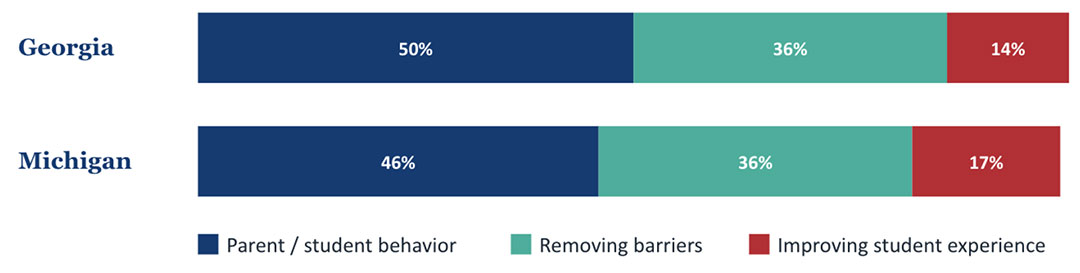
- Behavior-change practices accounted for 50% of attendance practices in Georgia and 46% in Michigan.
- The single most common practice in both states was sending letters home, reported by 76% of Georgia schools and 94% of Michigan schools. Communicating the importance of attendance, making phone calls, and offering attendance incentives were also widely used strategies.
- These practices are inexpensive and easy to implement, and they fit existing school routines. But prior research suggests their effects on attendance are modest, and they do little to address the underlying reasons students miss school.
Figure 1: Both states concentrate attendance practices in the lowest-impact category (changing parent /student behavior)
- Practices that remove out-of-school barriers were the second most common category, but many practices with the strongest evidence within this category were used inconsistently.
- Practices that remove out-of-school barriers to attendance accounted for 36% of attendance practices in both states.
- Some practices in this category were widespread: social services referrals, homelessness referrals, and mental health support were reported by the majority of schools.
- The highest-impact specific practices were much less common. Only 30% of Georgia schools and 41% of Michigan schools reported arranging transportation, and only about a third reported using home visits.
- These practices tend to require funding, staffing, and cross-sector partnerships that fall outside schools' traditional capacity, which likely explains why the more resource-intensive options remain rare.
- Practices focused on improving or adjusting students' experiences in school were the least common category, despite their research-supported link to attendance.
- Practices to improve student experiences accounted for only 14% of attendance practices in Georgia and 17% in Michigan.
- Within this category, social-emotional learning (44% in Georgia, 67% in Michigan) and restorative practices (33% and 59%) were the most common; nearly all other practices in the category were reported by fewer than 25% of schools.
- Research does show that improving school climate, belonging, and student-teacher relationships are linked to better attendance, but these efforts are often not framed or measured as attendance strategies. The authors suggest these practices may be the least common because schools don't see them as attendance strategies.
- Schools used a similar mix of attendance practices regardless of context, which suggests they are not necessarily tailoring strategies to their students' needs.
- Within each state, the share of practices in each of the three categories varied only modestly by chronic absenteeism rate, student demographics, locale (urban, suburban, rural), school level, or sector (traditional public vs. charter). A high-absenteeism urban high school serving predominantly low-income students used roughly the same mix of attendance practices as a low-absenteeism rural elementary school serving a different population.
- Schools with high chronic absenteeism were more likely to identify attendance as a top priority, but they did not meaningfully shift the type of practices they used in response.
- This suggests schools are converging on a common mix of strategies regardless of the specific challenges they face or the populations they serve. This means schools may be investing time and resources in strategies that are not well-matched to the drivers of absenteeism in their schools.
- State policy seems to meaningfully shape which practices schools use when responding to absenteeism.
- Georgia principals were substantially more likely to report using formal attendance systems: attendance teams (81% vs. 49%), early warning systems (64% vs. 32%), and MTSS (73% vs. 63%). Georgia's Senate Bill 123, passed in 2025, requires districts to establish attendance review teams and adopt formal intervention processes when chronic absenteeism crosses statutory thresholds. Michigan has no comparable mandate, so the authors interpret Georgia’s greater use of formal attendance systems as a direct response to state law.
- Michigan principals were substantially more likely than Georgia principals to report implementing mental health supports (81% vs. 59%), social-emotional learning (67% vs. 44%), and restorative practices (59% vs. 33%). The authors attribute this to Michigan's recent emphasis on student mental health, which has included expanded school funding and state-issued guidance for building comprehensive school mental health systems. Aligned with this, 34% of Michigan principals identified social, emotional, and mental health as a top-three priority for the year, compared to 14% in Georgia.
Only about half of schools have data systems that track why students are absent.
- 50% of Georgia schools and 48% of Michigan schools reported having a data system to track the reasons for students’ absences (illness, transportation, mental health, family emergency, housing instability, work, caregiving, etc.).
- Without this information, schools cannot easily diagnose root causes and are more likely to default to generic, lower-impact responses regardless of what is actually driving absences on their campus.
POLICY AND PRACTICE IMPLICATIONS
Schools across very different contexts are pulling from the same generic mix of practices, with schools doing more in the lowest-impact category of practices. This pattern reflects three connected gaps: (1) Schools do not have clear data on why their students are absent, (2) they do not have tools for matching practices to root causes, and (3) they do not have clear signals about which practices are most likely to work. Closing these gaps requires action on all three fronts.
Close the data gap: equip schools to diagnose why their students are absent, not just who is absent.
Without reasons data, schools cannot match strategies to causes and default to generic communication practices. States and districts can close this gap by:
- Exploring effective outreach strategies (such as home visits or personalized text messages) to identify the reasons that students miss school.
- Developing data systems to help schools log reasons during outreach, and prioritizing this data collection rather than treating it as optional.
- Building dashboards that surface the most common reasons at the school level so principals and attendance teams can see what is driving absences in their building and implement practices that address these root causes.
Give schools tools and resources to translate diagnostic data into practice selection.
Once schools can see why their students are absent, they need a structured way and adequate resources to translate that information into action. For example, knowing that transportation is the leading driver of absences in a school is only useful if the school's leadership knows which specific practices effectively address transportation barriers and has the resources to implement them. States, districts, and intermediary organizations can close this gap by:
- Providing tools and resources that pair common absence causes with specific practices most likely to address them (e.g., transportation barriers → arranged district transportation, Safe Routes to School, partnerships with local transit).
- Building these tools and resources directly into attendance planning processes, so schools cannot select practices without first identifying the causes those practices are meant to address.
- Training attendance teams and school leaders on how to use diagnostic data to drive practice selection and how to monitor the effectiveness of their strategies, rather than selecting practices first and looking for justification after.
- Creating cross-sector partnerships to address root causes beyond schools’ reach, allowing schools to focus on strategies they are best suited to implement.
Close the evidence gap: publish and elevate clear guidance on attendance practices by strength of evidence.
The paper shows that schools are pulling from a wide menu of practices (about 11 to 13 per school) with little signal about which items on the menu are most likely to move attendance. Even schools that diagnose causes well and try to match practices accordingly will struggle if the broader field has not clearly distinguished evidence-based practices from symbolic ones. Organizations such as Attendance Works and EdFuture have published useful guidance, but it is unclear how consistently states take it up and communicate it to schools and districts. State departments of education and intermediary organizations can build on this existing work by:
- Publishing guidance that groups specific practices by strength of evidence: practices with strong causal evidence (e.g., transportation supports, community schools, certain family engagement models), promising practices with mixed or emerging evidence, and low-evidence or symbolic practices that schools should not count as their primary attendance strategy.
- Updating this guidance regularly as new research emerges, and citing the underlying studies so school leaders can see the evidence for each group of practices.
- Integrating the guidance with the tools described above, so schools selecting practices for a particular cause can see both which practices fit the cause and which have the strongest evidence behind them.
- Districts can integrate attendance plans with other areas of school improvement, so that broader efforts to improve students' educational experiences count as attendance work.
- Practices focused on student belonging, relationships, and restorative approaches were the least commonly reported category, despite research linking school climate to attendance. One reason is that attendance plans are often developed in isolation from other improvement priorities like instruction and climate, so the day-to-day work of making school a place students want to be rarely registers as part of the attendance strategy. Districts can change this by connecting attendance planning to their broader school improvement efforts. For example, they could include climate indicators (e.g., student belonging surveys) in the same dashboards and reviews used to monitor attendance, and treat investments in social-emotional learning and restorative practices as part of the attendance plan rather than separate from it.
FULL WORKING PAPER
This report is based on the EdWorkingPaper "What are schools doing to improve attendance? Evidence from Michigan and Georgia," published in January 2026. The full research paper can be found here: https://doi.org/10.26300/qdq6-4s07.
The EdWorkingPapers Policy & Practice Series is designed to bridge the gap between academic research and real-world decision-making. Each installment summarizes a newly released EdWorkingPaper and highlights the most actionable insights for policymakers and education leaders. This summary was written by Christina Claiborne.