Nina Arshavsky, Julie A. Edmunds, Fatih Unlu, Lily Fesler
How does the Early College High School (ECHS) model (in which students take a college-prep math sequence from 9th through 11th grade) impact course‐taking and performance in math?
For decades, educators and policymakers have debated how to ensure more students graduate high school ready for college-level math. Completing rigorous math coursework is one of the strongest predictors of college access and success. Yet large numbers of students, particularly those who struggle early on, never make it through the full college-preparatory sequence.
The Early College High School (ECHS) model in North Carolina offers a potential solution. This study asks: Does ECHS improve math course-taking and academic performance for all students, and especially for underprepared students? This study provides new evidence on both the impacts of requiring rigorous math for all and the mechanisms, including the instructional practices and supports that help make it work.
THE EARLY COLLEGE HIGH SCHOOL MODEL IN NORTH CAROLINA
Early College High Schools (ECHS) are small, innovative public schools that are designed to ensure that every student graduates ready for postsecondary success. Students typically apply for admission and, within four to five years, can earn both a high school diploma and up to two years of transferable college credit or an associate degree, at no cost. These schools blend high school and college experiences, giving students early access to rigorous coursework and a clear, supported pathway to higher education or career credentials. These schools target students who are first-generation college-goers, from low-income families, or from groups underrepresented in higher education.
Some core components of the North Carolina ECHS model were:
- A focus on college readiness, including a default college preparatory curriculum. All students are expected to complete Algebra I by 9th grade and continue through subsequent rigorous mathematics courses.
- Early access to college credit courses. ECHS programs partner directly with colleges to enable students to enroll in credit-bearing college courses, often starting as early as 9th grade. This allows students to experience college-level rigor and expectations while still benefiting from high school supports, and it reduces the financial and logistical barriers to postsecondary completion
- Teaching and learning that emphasize rigorous, student-centered instruction. ECHS teachers went through extensive professional development and coaching to implement student-centered instructional strategies in every classroom.
- A personalized learning environment with strong staff-student relationships and academic and social supports for students. Extra help periods, tutoring, and close advising are built into the school schedule to ensure students succeed.
STUDY AND METHODS
This study examines the impact of the ECHS model in North Carolina on students’ math course-taking and success. This paper includes results from 1,434 treatment and 995 control students who applied to 19 early colleges for the fall of 2005 through 2009. The sample of ECHS students used in this study included 38% underrepresented in college, 46% low-income, and 38% first-generation college students.
The three research questions are:
- What is the impact of the Early College High School reform model on students’ course-taking and academic performance in mathematics in the 9th through 11th grade?
- How is the impact of the Early College High School reform model different for students with on-grade and below-grade academic preparedness?
- To what extent do early college mathematics teachers implement rigorous and student-centered practices in their classrooms?
Research Questions 1 & 2: Impacts of ECHS on Students’ Performance in Mathematics
This study used a lottery-based, randomized design to determine the impact of the ECHS model. When schools had more applicants than available seats, students were randomly selected through a lottery. This created two comparable groups: those admitted to ECHS (treatment) and those not admitted and who attended other local high schools (control). Tracking these students over time allows researchers to estimate the causal impact of attending an ECHS on student outcomes.
Research Question 3: Mathematics Teaching and Learning
The study used qualitative methods to analyze how mathematics instruction was implemented.
- Classroom observations: The researchers observed math classes to document how instruction was actually delivered. They described classroom activities in the categories of student work, lesson content, lesson instruction, assessment, and personalization.
- Interviews: 16 math teachers were interviewed about their classroom instruction and assessment.
KEY FINDINGS
Research Questions 1 & 2: Impacts of ECHS on Students’ Performance in Mathematics
- ECHS students were far more likely to complete college-preparatory math sequences than their peers in traditional schools.
- Nearly all ECHS students (about 97%) took at least Algebra 1 by the end of 9th grade, and about 94.5% successfully completed it. This is compared to about 89% of control group students (those in traditional high schools).
- By 11th grade, 89% of ECHS students had passed at least three college-prep math courses compared with 81% of control students.
- The ECHS model was particularly effective for academically underprepared students, suggesting that student-centered instruction can be beneficial for underprepared students.
By the end of 11th grade, underprepared ECHS students were about 15 percentage points more likely to have passed at least three college-prep math courses than underprepared control students (69.8% vs. 55.4%), a statistically significant gap. Prepared ECHS students also outperformed their control group by about 7 percentage points (95.9% vs. 89.2%), showing benefits for both groups but a substantially larger impact for underprepared students.
Figure 1: The percentage of students who passed at least three college-prep math courses by the end of 11th grade
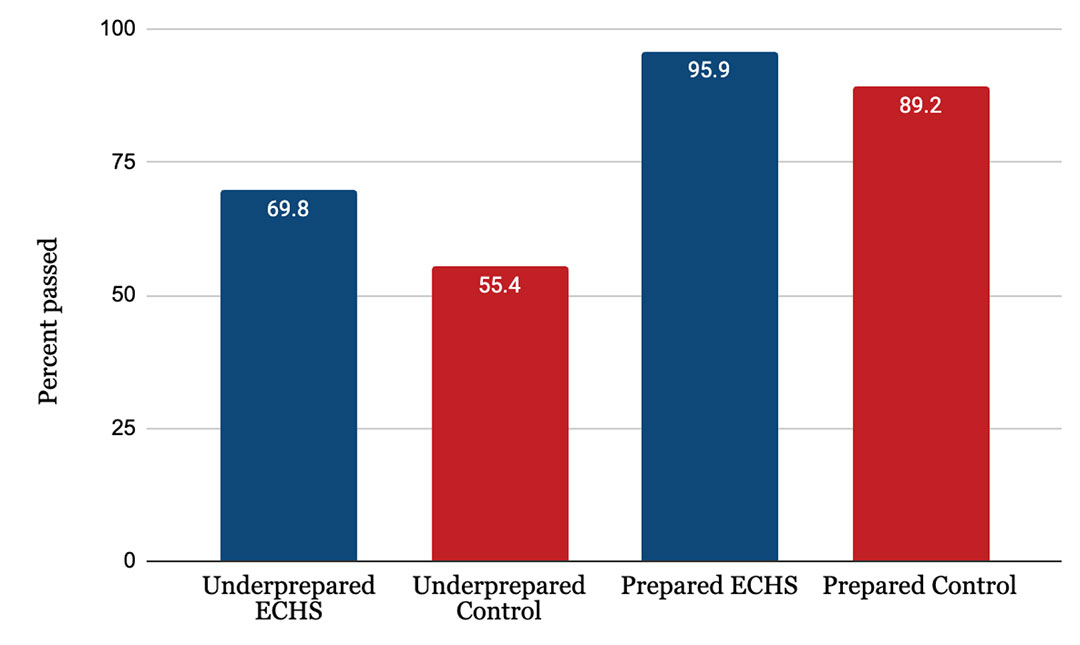
These findings show that the ECHS reform model effectively implements a universal Algebra policy within a broader college-prep framework, demonstrating that, with the right conditions, universal access to rigorous math can substantially increase learning for underrepresented, low-income, and first-generation students.
Research Question 3: To what extent do early college mathematics teachers implement rigorous and student-centered practices in their classrooms?
** The following results are descriptive and do not attempt to establish causal relationships between instruction and student achievement.
- Most ECHS classrooms shifted towards more student-centered practices, but still blended traditional and student-centered methods, reflecting an ongoing transition rather than full implementation.
- Following professional development under the ECHS reform, most math teachers reported, and observers confirmed, a shift toward more student-centered practices such as group work, mathematical discussions, and teacher facilitation rather than direct instruction.
- Rigorous instruction emphasizing higher-order thinking was observed in only 41% of classrooms, indicating progress but ongoing transition toward full rigor. Classrooms with explicit instruction tended to be less rigorous.
- Students’ survey responses from a different study seem to indicate that, in general, student-centered and rigorous instructional strategies occur to a greater extent in all core subjects at ECHS than in the comprehensive schools attended by control students (Edmunds et al., 2013.)
- Teachers emphasized that professional development and coaching were central to their instructional shifts under the ECHS reform.
- They described how ongoing support helped them move toward more rigorous, student-centered practices such as facilitating mathematical discussions, promoting peer learning, and positioning themselves as guides rather than lecturers in the classroom.
IMPLICATIONS FOR POLICY AND PRACTICE
- The ECHS model demonstrates that schools serving high proportions of underrepresented, low-income, and first-generation students can successfully implement universal Algebra I and college-prep math policies.
- This challenges the notion that raising rigor inevitably widens achievement gaps and instead shows that, with the right supports, universal access can promote equity.
- Professional development is likely a key driver for instructional change and preparing all students for college success.
- Teachers emphasized that professional development and coaching were central to their instructional shifts under the ECHS reform.
FULL WORKING PAPER
This report is based on the EdWorkingPaper “Improving College Readiness in Mathematics in the Context of a Comprehensive High School Reform,” published in January 2025. The full research paper can be found here: https://edworkingpapers.com/ai25-1131.
The EdWorkingPapers Policy & Practice Series is designed to bridge the gap between academic research and real-world decision-making. Each installment summarizes a newly released EdWorkingPaper and highlights the most actionable insights for policymakers and education leaders. This summary was written by Christina Claiborne.