Abigail Francis and Joshua Goodman
Five years after the pandemic began, families aren’t just bouncing back, they’re making different choices. In Massachusetts and across the country, enrollment in public schools remains below pre-pandemic trends, with many families opting for private and homeschooling instead. While some communities have returned to public schools, others, especially higher-income and White and Asian families, have continued to leave. The biggest shift is a surprising and persistent drop in enrollment in middle school grades.
These patterns suggest the pandemic didn’t just disrupt schooling; it may have reshaped what families want and expect from public education.
STUDY AND METHODS
This study examines how K–12 enrollment in Massachusetts evolved in the five years following the onset of COVID-19. To assess whether observed changes in enrollment patterns reflect temporary disruptions or long-term shifts, the authors used data from before the pandemic (2016–2019) to create a model that estimated expected enrollment through fall 2024. They then compared these predictions to the actual enrollment numbers, which enabled them to isolate the impact of COVID-19 and its aftermath on enrollment in public, private, and homeschool settings, as well as the effects on different student groups and grade levels.
KEY FINDINGS
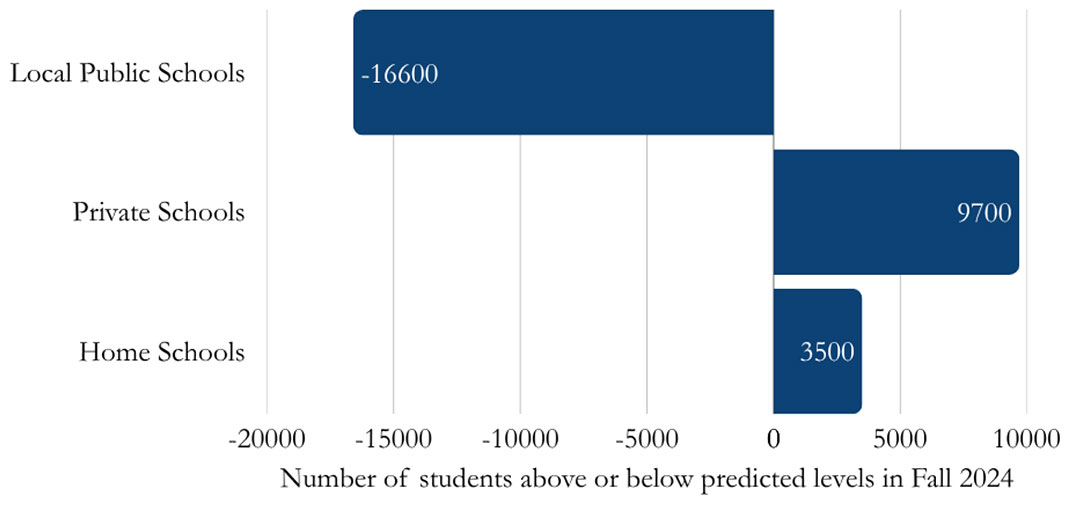
There has been a sustained shift away from public schools and towards private schools and homeschooling. By Fall 2024, local public school enrollment was down 2% (16,600 students) compared to pre-pandemic trends, while private school enrollment rose 14% and homeschooling increased by 45%. These shifts suggest lasting changes in parental preferences, with many families continuing to opt out of public schools even after COVID-related disruptions subsided.
Figure 1: Number of students above or below predicted levels in Fall 2024 by school type.
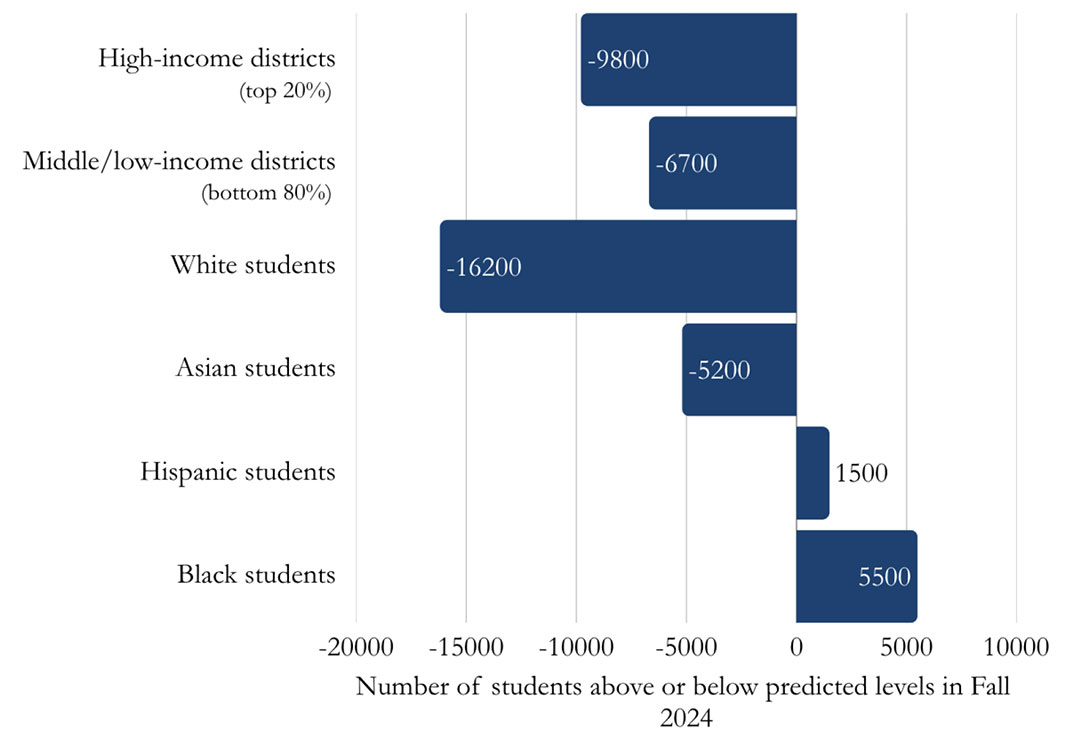
2. High-income, White, and Asian students were more likely to leave public schools early in the pandemic and have not returned. In contrast, Black, Hispanic, and lower-income families have largely re-enrolled in public schools, returning to pre-pandemic levels. This suggests that the pandemic has substantially shifted the racial/ethnic composition of public schools.
Figure 2: Number of students above or below predicted levels in Fall 2024 by income and race.
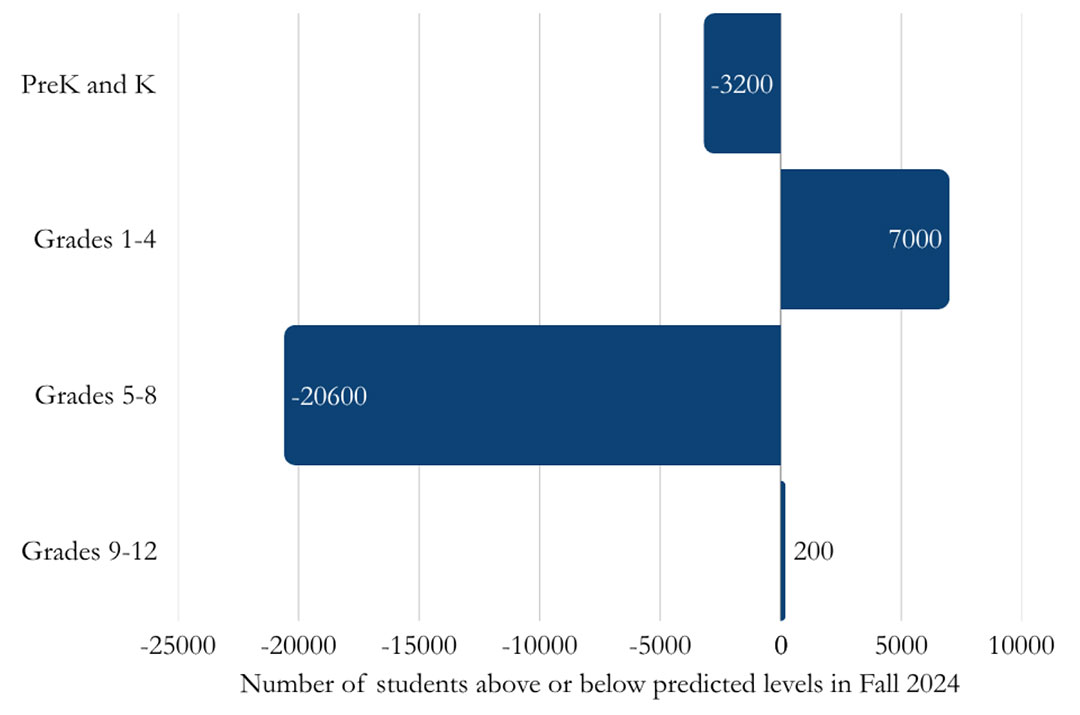
Middle school enrollment was hit the hardest, accounting for nearly all public school enrollment declines. Grades 5–8 saw an 8% drop in enrollment (20,600 students). Elementary and high school enrollment has mostly stabilized or recovered. The mechanisms driving this are unclear, but rising parental concerns about behavior, peer environments, and academic rigor may help explain the sharp decline in middle school enrollment.
Figure 3: Number of students above or below predicted levels in Fall 2024 by grade level.
- Fall 2024 public school enrollment trends in Massachusetts closely mirror national patterns from fall 2023, with both showing an overall enrollment decline of about 2.6–2.8% below predicted levels. In both cases, losses are concentrated in middle grades and among White and Asian students, while elementary and high school enrollments remained relatively stable, and Black and Hispanic enrollments showed greater recovery.
POLICY AND PRACTICE IMPLICATIONS
Public schools must adapt to evolving parental preferences to remain competitive. The sustained enrollment shift toward private and home schools suggests many families are seeking alternatives they perceive as offering better academic rigor, safety, or flexibility. This highlights the need to better understand and address the growing disconnect between what families want, particularly in middle grades, and what public schools currently offer.
Given that middle grades (5–8) account for nearly all of the net public school losses, districts should consider targeted strategies to improve the student experience in these grades. This might include more rigorous academics, improved behavioral supports, stronger student-teacher relationships, and expanded elective or extracurricular offerings that make middle school feel more engaging and safe
The departure of many higher-income families may reduce public school funding and weaken overall support for the public education system. With higher-income, White, and Asian families exiting public schools at higher rates, public systems could see reduced political and financial support, especially in communities where enrollment declines are steepest. States and districts may need to consider how to maintain equitable funding formulas.
Enrollment monitoring should be ongoing and disaggregated. Because these patterns vary by grade level and demographic group, districts and states need real-time data systems to track enrollment by student subgroup and school type. Monitoring these trends will be essential for resource planning, equity analyses, and long-term strategic decisions.
FULL WORKING PAPER
This report is based on the EdWorkingPaper “School Enrollment Shifts Five Years After the Pandemic,” published in June 2025. The full research paper can be found here: https://edworkingpapers.com/ai25-1233
The EdWorkingPapers Policy & Practice Series is designed to bridge the gap between academic research and real-world decision-making. Each installment summarizes a newly released EdWorkingPaper and highlights the most actionable insights for policymakers and education leaders. This summary was written by Christina Claiborne.