Brendan Bartanen, Andrew Avitabile, and Andrew Kwok
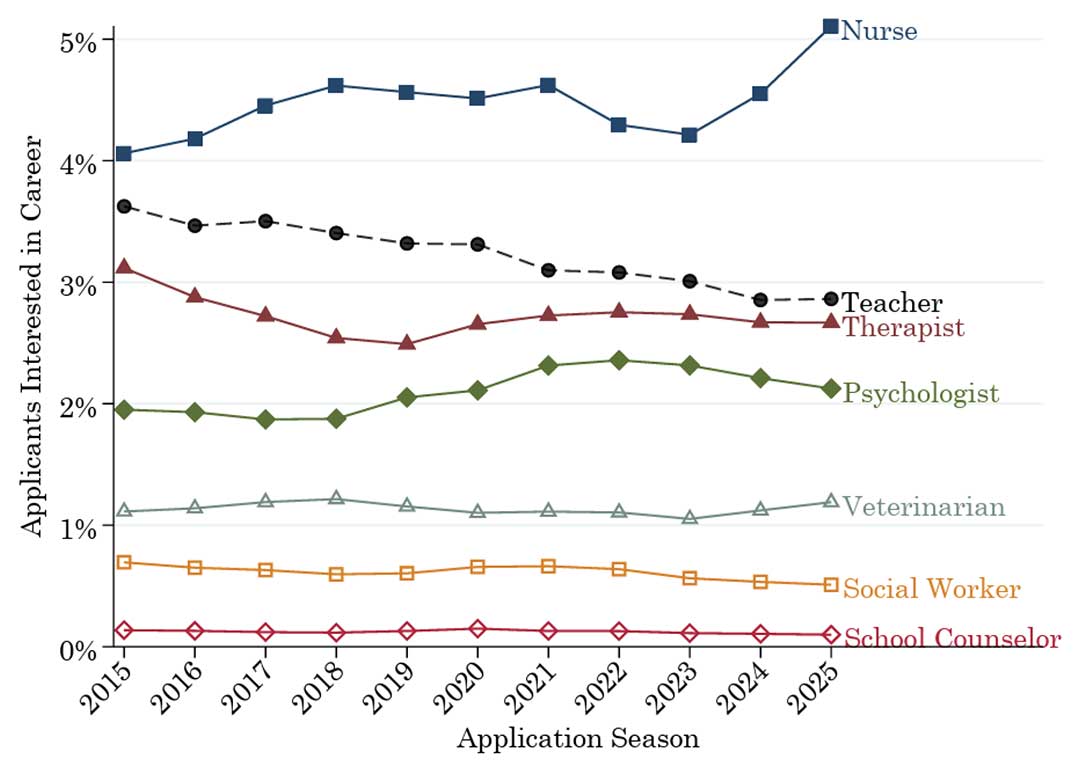
Over the past decade, interest in teaching has dropped by roughly 20 percent, even as applications to nursing (a career path that attracts similar students) have climbed. At a time when schools face growing shortages and urgently need a more diverse workforce, this trend is setting off alarm bells for policymakers and education leaders.
Effective solutions require understanding the teacher pipeline.. Research on teacher supply has a long history, but a major gap has been in examining initial interest in teaching and how that interest varies across demographic, academic, and institutional dimensions.. This study fills this gap by leveraging data from 11.5 million college applicants to offer the most granular portrait to date of early interest in teaching.
This study shows the teacher pipeline through the same lens as other professions, and the contrasts are stark. Unlike nursing or social work, teaching struggles to attract students of color. Unlike law or engineering, it draws fewer high-achieving students who seem motivated by prestige and advancement. While the paper does not claim to identify the exact drivers of these patterns, it highlights important hypotheses, such as the possibility that low professional prestige may deter some talented students from entering teaching. In doing so, it reframes the teacher shortage not only as a question of supply, but also as an issue of status and opportunity, raising important questions about how to recruit, support, and elevate teaching to make it both accessible and appealing to the next generation.
STUDY AND METHODS
This study draws on over 11.5 million college applications submitted between 2014 and 2025 to better understand who wants to be a teacher, how those students compare to peers pursuing similar professions like nursing or social work, and what traits or motivations shape those choices. The authors focus on students who list education as a potential field of study on their applications and compare them to peers interested in alternative career paths that attract similar students, including therapy, psychology, nursing, social work, and school counseling, as well as to applicants in more selective fields like law and engineering. Even though self-reported career interests can obviously change, past studies find that expressing interest in teaching on college applications is a strong signal of later pursuing a teacher certification major or entering a teacher prep program.
To understand what factors influence a student’s interest in teaching, the authors use statistical models that control for student demographics, academic performance, and application behavior (i.e., how many colleges a student applied to and the types of schools they chose). The authors also use ratings from high school teacher recommendations to capture students’ non-academic traits, such as concern for others, self-confidence, and intellectual promise.
KEY FINDINGS
Interest in teaching has dropped about 20% over the past decade. In contrast, interest in nursing has surged by 25%. Interest in teaching dropped from 3.6% of applicants in 2015 to 2.9% in 2025. If teaching interest had held steady at 2015 levels, about 48,000 applicants in 2025 would have indicated interest in teaching. Instead, only 38,000 did — a decline of roughly 10,000 potential future teachers in a single year.
Figure 1: Percent of Applicants Indicating Interest in Teaching and Similar Careers
Students who apply to more selective institutions are substantially less likely to be interested in teaching, regardless of their academic ability, likely because they want more prestigious careers. Students interested in teaching have somewhat lower test scores, on average. But once the authors control for how many colleges a student applies to and whether those colleges are highly selective, that relationship mostly disappears. This means the real driver isn’t academic ability, but ambition and prestige-seeking. Students who cast wide nets at selective colleges are signaling they want competitive, high-status careers, and those students are much less likely to choose teaching. In other words, teaching doesn’t necessarily attract lower-achieving students; it fails to attract high-achieving students who are often aiming for more prestigious or better-paid professions. This pattern is comparable among similar careers.
Students interested in teaching are rated by recommenders as having higher concern for others but lower self-confidence and intellectual promise. This suggests that students drawn to teaching may see (or be seen as having) fewer academic options, which could reinforce broader perceptions of teaching as a “fallback” career rather than a prestigious one. Together, these patterns suggest that teaching appeals to students with strong service motivations but may also carry stigmas around status and intellectual rigor.
Teaching attracts more women, similar to other “helping professions.” Women are about three times more likely than men to express interest in teaching, which roughly mirrors the current 1:3 male-to-female ratio of the K–12 teacher workforce. Other “helping professions” are also female-dominated.
Teaching attracts more White students, whereas other “helping professions” attract relatively diverse groups of applicants. This suggests that there are reasons specific to the teaching profession that dissuade diverse students from an interest in teaching. Black students, in particular, are about one-third as likely as White students to indicate interest in teaching on their college applications. The authors hypothesize that these racial and ethnic gaps in student interest are due to:
- Representation: K–12 experiences for students of color often don’t include teachers who share their racial or ethnic background. Without those role models, teaching may feel less relevant or attainable.
- Previous experiences: Students of color and those from low-income backgrounds may be less drawn to teaching because their own school experiences felt punitive rather than empowering, leaving them with fewer positive role models in teaching and more in other helping professions like social work, counseling, or nursing.
IMPLICATIONS FOR POLICY AND PRACTICE
Raising the prestige of teaching and creating clear advancement pathways could help attract academically high-achieving students. By positioning teaching as a respected profession with opportunities for growth, such as specialized roles, leadership tracks, or higher pay for advanced skills, leaders can broaden the appeal of teaching beyond service-oriented motivations and make it a competitive option for top students. Additionally, since nursing has successfully increased interest over time, while teaching has declined, understanding how nursing markets itself and supports students may offer lessons for strengthening teacher preparation pipelines
Make teaching a more competitive financial option. Raising base salaries is the most obvious step, but additional measures can make teacher preparation more attractive: service-based scholarships and loan forgiveness programs can reduce long-term debt; paid teacher residencies can help candidates support themselves while completing training; and earlier financial supports during college can prevent students from abandoning teaching for better-paying options.
Specifically address barriers that make teaching less appealing to students of color. Unlike other helping professions (e.g., nursing), teaching suffers from disproportionately low interest among Black and Asian students. If policymakers want to diversify the pipeline, solutions for teaching can’t just be borrowed from other helping fields like nursing; they need to directly address the racial disparities in who sees teaching as a viable or appealing career. Partnerships with HBCUs and community-based organizations could strengthen recruitment pipelines.
FULL WORKING PAPER
This report is based on the EdWorkingPaper “Who Wants to Be a Teacher in America?,” published in September 2025. The full research paper can be found here: https://edworkingpapers.com/ai25-1275
The EdWorkingPapers Policy & Practice Series is designed to bridge the gap between academic research and real-world decision-making. Each installment summarizes a newly released EdWorkingPaper and highlights the most actionable insights for policymakers and education leaders. This summary was written by Christina Claiborne.