David Figlio and Umut Özek
New Study Finds That Banning Cellphones in Schools Reduces Absences and Boosts Test Scores Over Time
The rapid rise of student smartphone ownership, now reaching 88% among U.S. teens, has coincided with growing concern about both student well-being and academic performance. At the same time, 72% of public high school teachers say cellphones are a major classroom problem, and 83% of educators support all-day restrictions with limited exceptions. Supporters of cellphone bans argue that restricting device use helps students stay focused, reduces distractions, and improves mental health and academic performance. Opponents counter that such policies may strain student–teacher relationships, limit access to digital learning tools, and hinder communication during emergencies
By 2024, nearly one-third of countries had enacted national cellphone bans in schools, and in the United States, 30 states have passed or recommended policies limiting student phone use. Yet despite the growing momentum behind these policies, there has been little rigorous evidence about their actual effects on student outcomes.
This new study from Florida offers some of the clearest evidence to date. In July 2023, Florida enacted one of the nation’s most far-reaching policies to curb cellphone and social media use in schools. The law prohibits students from using wireless devices, including smartphones, earbuds, headphones, and smartwatches, during instructional time, except when explicitly allowed by a teacher for educational purposes. Teachers must designate a specific area for storing phones during class.
By studying the rollout of this ban, the researchers found that while suspensions initially rose, especially among Black students, those effects faded as schools adjusted. Within a year, schools enforcing bans saw significant reductions in unexcused absences and modest but meaningful gains in test scores. The findings suggest that cellphone bans can improve school engagement and academic performance. However, they also underscore the need for careful rollout and monitoring to avoid unintended consequences during the adjustment period.
STUDY AND METHODS
This study takes advantage of the statewide rollout of Florida’s 2023 cellphone ban, which prohibited student use of phones and other wireless devices during instructional time. The analysis focuses on a large urban county-level school district (which the authors refer to as LUSD), one of the ten largest in the United States. Because schools in LUSD differed in how much students used phones before the ban, researchers could compare how outcomes changed for schools where phone use had been most prevalent versus those where it had been less common before and after the policy took effect.
Using administrative data on more than 130,000 students, the researchers employed a difference-in-differences approach. This method compares how key outcomes, such as disciplinary incidents, test scores, and attendance, changed over time for two groups:
- Treatment schools: Those with high levels of student smartphone activity before the ban (where the policy was likely to have the greatest impact).
- Comparison schools: Those with lower levels of pre-ban smartphone activity (where the ban likely produced smaller or minimal changes).
By examining the difference in outcomes between these groups before and after the ban, the study isolates the policy’s effect from other statewide trends, such as shifts in student behavior or district policy changes that affected all schools. This approach provides causal evidence on the impact of cellphone bans, though it likely understates the full effect, since even lower-activity schools were partially affected once the statewide ban took effect.
In short, the study asks: Did outcomes improve most in schools where phones were used most heavily before the ban, suggesting that taking phones away made a measurable difference?
KEY FINDINGS
- Implementing schoolwide cellphone bans increased disciplinary incidents in the first year, primarily among Black students, male students, and students in middle and high school.
- In the first year, suspensions rose by 12% (relative to the comparison group mean) and in-school suspensions increased by about 20%.
- These effects were primarily driven by Black students, whose in-school suspensions rose by roughly 30%, while the policy had no significant effect for White and Hispanic students. This suggests that the transition period following the ban may have amplified existing disciplinary disparities.
- Male students saw a large, significant increase in disciplinary incidents, and female students saw no increase.
- In middle and high schools where student smartphone use is more common, the ban increased disciplinary incidents by 15 to 20 percent in the first year, while it had no effect in elementary schools.
- By the second year, the increase in disciplinary incidents disappears, suggesting the initial spike reflected a transitional adjustment period as schools implemented the policy.
Student achievement improved modestly in the first year and more substantially in the second year after phones were removed from classrooms.
- The ban increased scores on spring accountability tests by 1.1 percentiles overall in the second year relative to the spring test right before the ban took effect. There were slightly larger effects for Black students, White students, male students, and middle and high school students. No significant effects were found for female or elementary students.
Figure 1: Test scores improved after the 2023 cellphone ban, particularly in schools that had higher pre-ban smartphone use.
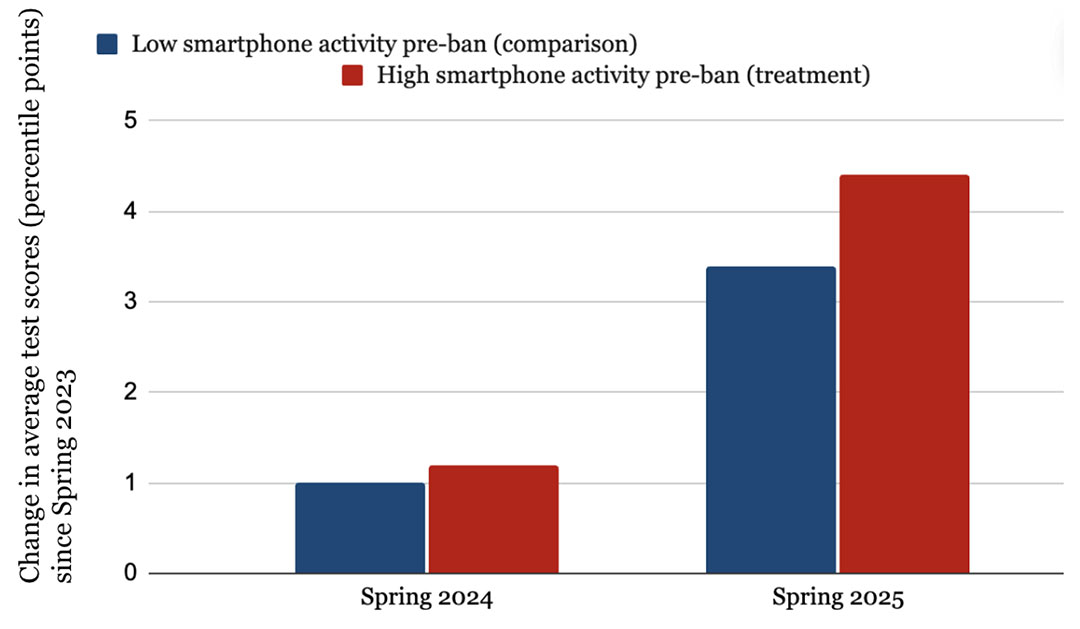
This figure is based on end-of-year test data from students in LUSD. All values represent gains relative to scores from Spring 2023 (before the ban went into effect).
- 4. The ban reduced unexcused absences in both first and second years for students in middle and high schools, providing suggestive evidence that improved student engagement and school climate could be important factors behind the observed test score benefits.
- The authors statistically tested whether part of the reason test scores went up is because attendance improved. They found that the improvement in attendance could account for around half of the observed test‐score gains in those grades. In other words, a significant portion of the gain in test scores is plausibly because students were present more often (i.e., less unexcused absence) and thus had more instructional exposure.
- There was no significant effect on student absences in elementary schools
- There does not seem to be any impact of a cellphone ban on disciplinary incidents, attendance, or test scores in elementary schools.
IMPLICATIONS FOR POLICY AND PRACTICE
- Cellphone bans may unintentionally amplify existing racial disparities in discipline if enforcement is inconsistent or overly punitive. Ensure that cellphone restrictions are implemented equitably and monitored for disproportionate disciplinary impacts.
- The rise in disciplinary incidents, driven primarily by Black students, suggests that schools should proactively monitor enforcement and use data to identify and address any uneven impacts during rollout.
- Anticipate short-term adjustment challenges when implementing cellphone bans.
- Districts should expect a temporary increase in disciplinary incidents, particularly in middle and high schools, where phone use is most common. Proactive communication with students and families, clear expectations, and teacher training on consistent enforcement can help minimize disruption and maintain a positive school climate during the transition.
- Pair cellphone bans with broader efforts to strengthen engagement and attendance.
- Over time, the policy was associated with improved attendance and test scores, suggesting that reducing distractions can enhance student focus and academic performance. Schools can amplify these gains by linking cellphone policies with attendance interventions, advisory programs, or social-emotional supports that encourage sustained engagement.
FULL WORKING PAPER
This report is based on the EdWorkingPaper “The Impact of Cellphone Bans in Schools on Student Outcomes: Evidence from Florida,” published in October 2025. The full research paper can be found here: https://edworkingpapers.com/ai25-1315.
The EdWorkingPapers Policy & Practice Series is designed to bridge the gap between academic research and real-world decision-making. Each installment summarizes a newly released EdWorkingPaper and highlights the most actionable insights for policymakers and education leaders. This summary was written by Christina Claiborne.