
Joshua Goodman and Joseph Winkelmann
As community college enrollment has fallen over the last 15 years, how much of the drop can be attributed to a strong labor market, and how much points to bigger challenges within higher education?
Community colleges have long served as the entry point to higher education for millions of Americans, especially first-generation students. Yet over the past decade, these institutions have experienced a striking decline in enrollment. Enrollments peaked in fall 2010 and by fall 2023 had fallen 37% from that peak. Policymakers and practitioners have raised concerns that this trend could signal falling confidence in the value of college, growing barriers to access, and the erosion of a critical workforce pipeline. Understanding what is truly driving these declines is essential for designing policies and supports that ensure community colleges continue to help students gain the skills they need to move into stable, well-paying careers, during times of both good and bad economic conditions.
This new study offers the clearest picture yet of what is behind the drop. Using national data from 1990–2023, the authors disentangle changes in labor markets and data reporting from genuine shifts in student demand. Their analysis reveals that much of the decline in community college enrollment reflects a stronger job market, not a collapse in interest or value, and that, despite fewer enrolled students, degree completions have remained steady and completion rates have improved. This evidence challenges common narratives of institutional failure and reframes the issue as an economic and policy coordination problem: how to design more flexible, resilient postsecondary pathways that respond to changing labor market conditions.
STUDY AND METHODS
Using college enrollment data from the Integrated Postsecondary Education Data System (IPEDS) linked to county-level unemployment rates from the Bureau of Labor Statistics, the researchers track enrollment, completion, and labor market conditions from 1990 to 2023.
To understand how much of the post-2009 community college enrollment decline is tied to job markets strengthening in the wake of the Great Recession, the authors first estimated how enrollment historically responded to changes in local unemployment before the Great Recession (1990-2007). Using those earlier relationships, they then projected what community college enrollment should have looked like in later years based on actual changes in unemployment and local population. By comparing these predictions to the real enrollment numbers, the researchers were able to estimate how much of the recent decline can reasonably be explained by improved labor-market conditions versus other forces affecting colleges.
KEY FINDINGS
The national overall college enrollment decline is concentrated in two-year community colleges, not four-year institutions.
- While total U.S. undergraduate enrollment has fallen by more than 12% since 2010, this decline is driven almost entirely by the two-year community college sector, which has lost roughly 37% of students since its 2010 peak. Enrollment at public and private four-year institutions has remained largely stable or grown slightly.
Figure 1: First-time undergraduate enrollment by sector
- 60% of the decline in first-time community college enrollment from 2009-19 can be explained by improved job opportunities rather than decreased interest in higher education. This implies that students often see community college and immediate employment as substitute choices, enrolling in college during weak job markets and entering the workforce when there are many job opportunities.
- A 1 percentage point rise in the local unemployment rate increases first-time community college enrollment by about 2%, showing that many students weigh college against work opportunities. For-profit colleges show similar patterns (rising during economic downturns and falling during strong labor markets), while four-year colleges are largely unaffected by labor market changes.
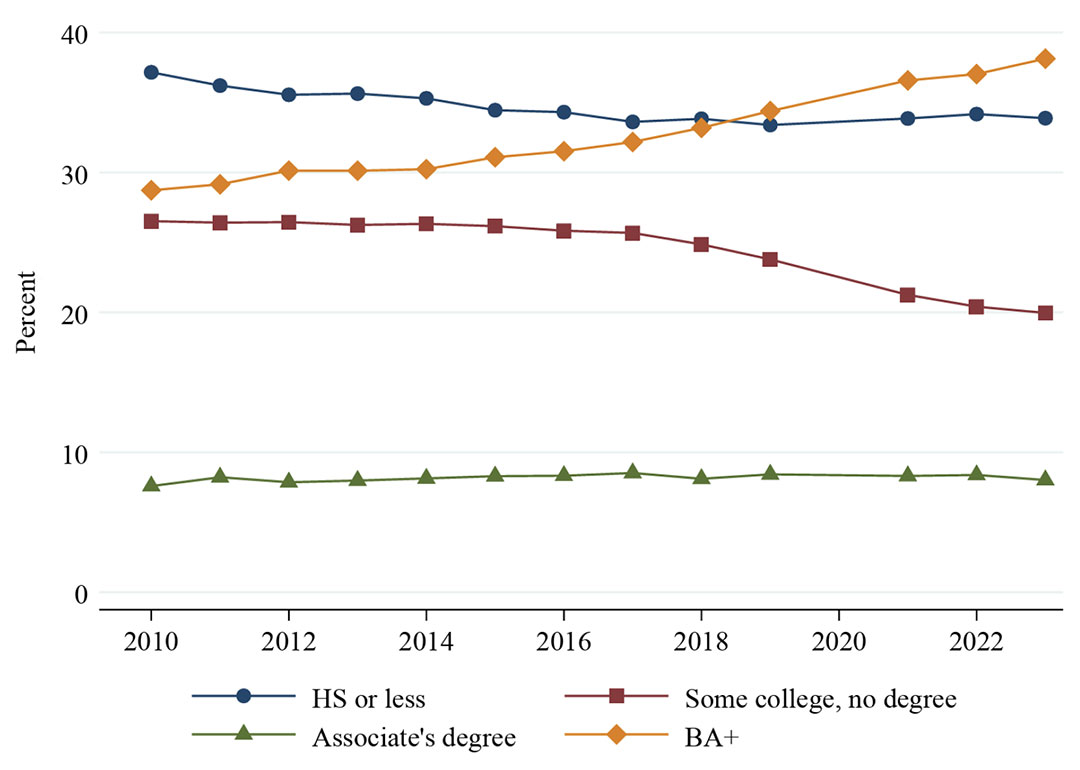
Despite steep enrollment declines, the share of Americans with associate’s degrees has remained stable since 2010, and completion rates have risen from 21% to 34%.
- These patterns suggest that the enrollment declines are mostly occurring among students who were least likely to complete a degree. For these students, earning steady wages right away may actually be a more beneficial or rational choice than starting college and risking noncompletion.
Figure 2: Educational attainment of 25-year-olds

- Roughly one-third of the reported community college decline is because some community colleges were reclassified as four-year institutions in federal data, even though most students still pursued associate’s degrees.
- Many community colleges began offering limited bachelor’s programs during the 2010s and were reclassified as four-year institutions in federal data, even though most students still pursued associate’s degrees. Correcting for this reclassification reduces the true decline in community college enrollment from 37% to about 21%.
IMPLICATIONS FOR POLICY AND PRACTICE
- Community college enrollment declines largely reflect students responding to improving job opportunities rather than losing confidence in higher education.
- While lower enrollment certainly strains community college budgets, it may also signal that these institutions are successfully serving students who make reasonable choices based on available job opportunities.
- State and system leaders should avoid treating higher education enrollment declines as a uniform “crisis” and instead examine trends separately for community colleges, four-year institutions, and other sectors.
- Because much of the decline is concentrated in two-year colleges and is closely tied to local labor-market conditions, not a broad loss of faith in college, policies should be tailored to the specific students and institutions most affected rather than applying one-size-fits-all solutions across the entire higher education system.
- Systems should develop “automatic stabilizers” that help scale community college programs quickly during economic downturns, since enrollment rises when unemployment increases.
- Workforce and economic-development policies should recognize that some students are making reasonable choices to work during strong labor markets; strengthening on-ramps back into college and flexible program models may help reconnect those students when the timing is right.
- Focus on student success, not just enrollment counts.
- Rising completion rates alongside falling enrollment suggest that community colleges may now be serving a smaller group of students who are more likely to persist and finish. For policymakers, this means that headline enrollment declines do not automatically translate into weaker outcomes for students or diminished institutional performance.
- Strengthen data systems to accurately track sector trends.
- Roughly one-third of the apparent enrollment loss stems from institutional reclassification, not actual attrition. Federal and state data systems should distinguish community colleges that offer bachelor’s degrees from traditional four-year institutions, ensuring that funding, accountability, and research are based on accurate sector definitions.
FULL WORKING PAPER
This report is based on the EdWorkingPaper “Labor Market Strength and Declining Community College Enrollment” published in November 2025. The full research paper can be found here:https://edworkingpapers.com/ai25-1338.
The EdWorkingPapers Policy & Practice Series is designed to bridge the gap between academic research and real-world decision-making. Each installment summarizes a newly released EdWorkingPaper and highlights the most actionable insights for policymakers and education leaders. This summary was written by Christina Claiborne.