Biraj Bisht, Sade Bonilla, Grace (Ha Eun) Kim, and Emily K. Penner
What are Ethnic Studies courses, and how are they expected to affect student learning?
Across the country, student engagement is slipping, and more students are checking out. And when students feel disconnected, they are more likely to disengage from coursework, miss school, and struggle academically.
Ethnic Studies (ES) has emerged as a promising approach to address this challenge. By centering the histories, cultures, and lived experiences of communities of color, ES is designed to make learning more relevant and meaningful. ES is rooted in the premise that when students feel seen, respected, and connected to what they are learning, they develop increased motivation and engagement in ways that carry over into other classes. By creating space for students to explore issues of identity, culture, and social context, ES aims to strengthen students’ sense of belonging and help them see themselves reflected in the curriculum in ways that traditional coursework often does not. In this way, ES is not just a course about identity or equity; it is an academic intervention. By shaping how students engage with school, it creates the conditions for improved performance across their coursework.
What have earlier studies shown about the effects of ES, and what new evidence does this study contribute?
Early pilot studies in San Francisco offered compelling evidence that ES could improve academic outcomes. A landmark quasi-experimental study found that 8th graders with GPAs below 2.0 who were encouraged to take ES saw meaningful gains in their 9th grade GPA, attendance, and course credits, and those benefits extended all the way through high school and into college enrollment rates. These were not modest effects: they ranked among the largest produced by any curriculum-based intervention studied at the time, and they generated significant excitement about ES as a tool for educational equity.
But the research had a crucial limitation: it was built on a small, carefully designed pilot program, run by a group of self-selected, deeply committed teachers, and targeted almost exclusively at the students most likely to benefit. Critics and skeptics raised fair questions. Would the results replicate when ES moved beyond that original team of true believers into the hands of teachers who hadn't sought out the course? Would it still work for students who were already performing well, or who came from different racial and ethnic backgrounds than the curriculum was originally designed to center? And perhaps most pressingly, would the program survive the messy, resource-constrained reality of district-wide implementation, where not every school has the same capacity, culture, or administrative support?
These are not merely academic questions. Education research is littered with promising pilots that collapsed at scale. What works in one well-resourced school with motivated teachers and a self-selected student body often looks very different when replicated across dozens of schools under a mandate. For ES in particular, the stakes of getting this wrong are high: states like California are now requiring the course for graduation, meaning millions of students will take it regardless of whether their school is ready to deliver it well.
This study answers that question using over a decade of data from the San Francisco Unified School District (SFUSD), one of the earliest and most sustained district-wide ES implementations in the country. SFUSD began formally piloting ES in 2010, gradually expanded it across all high schools, and ultimately adopted a graduation requirement for the class of 2028. The results carry significant implications, not just for California, which recently became the first state to require ES for graduation, but for any district or state weighing whether a culturally responsive curriculum is worth the investment.
STUDY AND METHODS
This study uses longitudinal student data from SFUSD spanning the 2007–08 through 2022–23 school years, covering nearly 40 middle and high schools. The primary sample includes 24,246 students tracked continuously from grades 6 through 12.
The researchers measured two key outcomes: students' annual GPA (on a 4.0 scale) and whether students failed any courses in a given year. Both outcomes exclude ES and PE courses. To isolate the effect of ES enrollment specifically, the study used a student-level two-way fixed effects model. Instead of comparing ES students to non-ES students at a single point in time, it compares each student to themselves, tracking how their own academic performance changes before versus after they enroll in ES. They then compare those changes to academic performance changes across middle and high school among students who never take ES.
The "student level two-way fixed effects" part of the design adds two additional layers of statistical control. The first is a student fixed effect, which controls for stable differences between students, like prior achievement, background, or motivation, so the estimated effects reflect changes caused by taking the course, rather than differences between the types of students who choose to enroll.
The second is a grade fixed effect, which controls for the fact that GPA tends to shift systematically as students move through school. By accounting for these grade-level patterns, the model isolates the ES effect from the normal ebb and flow of academic performance across the high school years. The researchers also used a synthetic difference-in-differences method, robustness checks, and falsification checks to further verify that their results were driven by participation in ES rather than other factors.
KEY FINDINGS
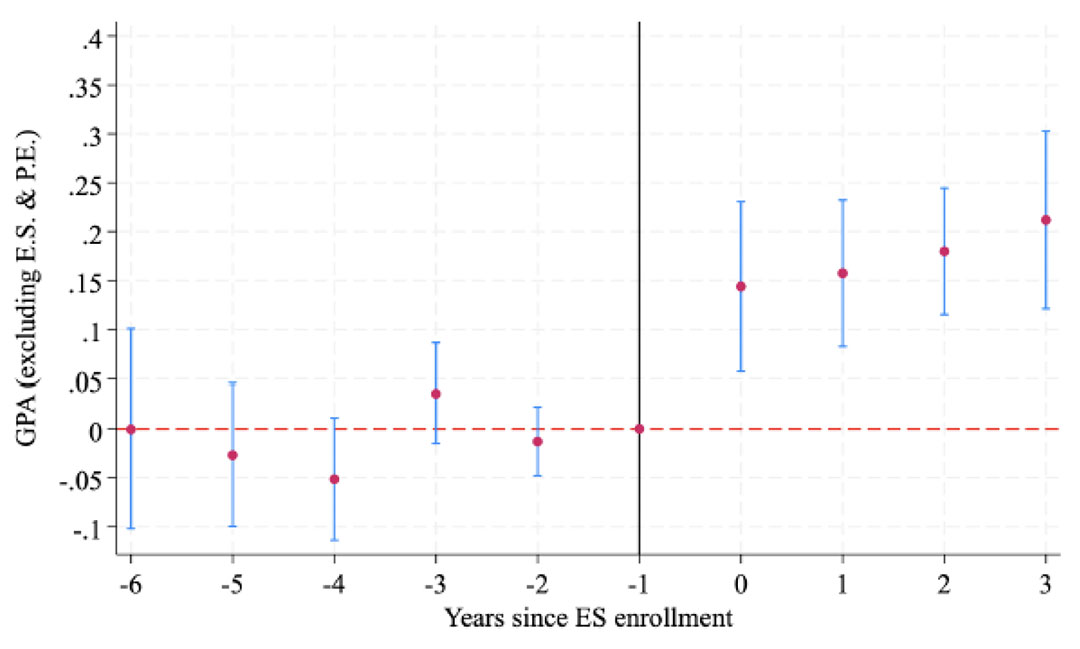
Ethnic Studies enrollment led to meaningful improvements in overall GPA and reduced course failures, with gains growing over time.
- On average, taking ES increased students' GPA by 0.17 grade points (0.24 standard deviations). This is a large effect size relative to most education interventions.
- These gains are not trivial in practical terms: the GPA increase translates to a 15% increase in students meeting the 3.0 GPA threshold required for University of California admission.
- Course failure rates dropped by 5.6 percentage points, a 31% reduction relative to the baseline failure rate of 21% (0.17 SD).
- This effect persists throughout high school, even three years after enrollment.
Figure 1: ES enrollment led to increases in GPA, with gains growing over time.
- The gains were especially strong in math and science, subjects with no obvious connection to ES content, suggesting that ES works by improving students' overall engagement, motivation, and sense of belonging in school more broadly.
- ES enrollment raised GPA not just in social studies or English, but across all core subjects. The largest improvements were in math (0.27 points) and science (0.20 points).
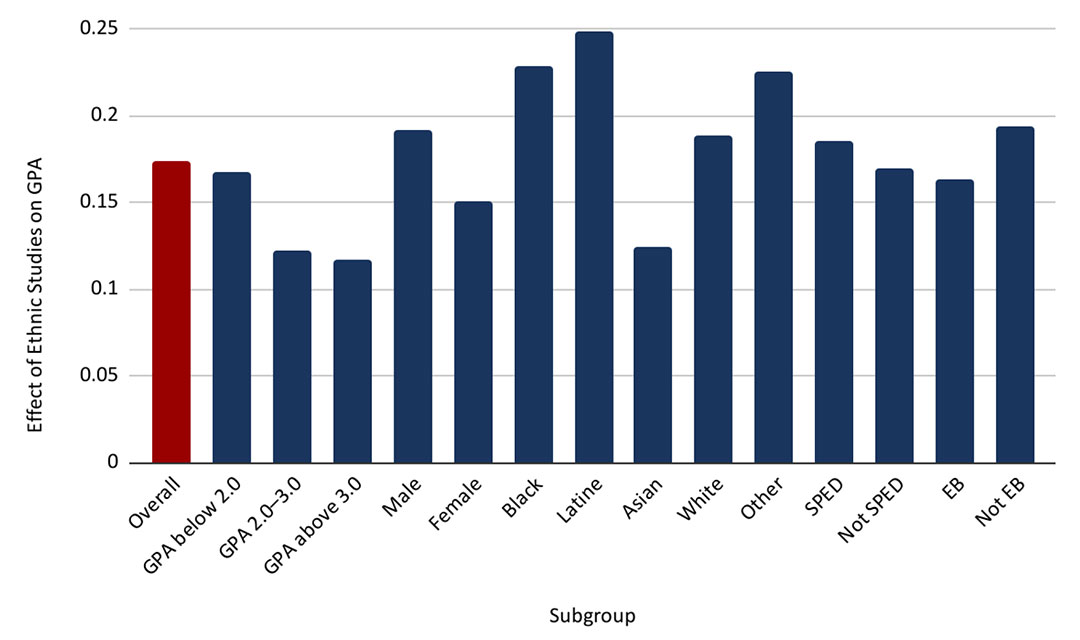
Ethnic Studies enrollment improved outcomes across all student groups, but had the strongest impact on students who stand to gain the most.
- Earlier studies primarily examined ES as a targeted intervention for students with low prior achievement (GPA below 2.0). This study finds consistent benefits across the full range of students, those with both low and high prior GPAs, across racial and ethnic groups, genders, and special education status, suggesting that ES can improve outcomes broadly.
- However, students with the lowest entering GPAs (below 2.0 in 8th grade), Black, Latine, and male students showed the largest gains and reductions in course failures. This pattern suggests that ES may be particularly effective at helping students who are at greater risk of falling behind and decrease longstanding disparities in student outcomes.
Figure 2: ES enrollment improved GPA across all student groups
- The strongest effects were found among students who enrolled in ES in 9th grade, when the transition to high school creates the greatest academic risk.
- Research consistently shows that 9th grade is a pivotal year, when students are most likely to fail courses, fall behind on credits, and disengage from school, factors that are strongly associated with later drop out.
- In this study, students who never took ES showed the characteristic GPA dip when they entered high school. Students who enrolled in ES in 9th grade did not. The course failure rate for 9th-grade ES enrollees dropped by 10 percentage points in the year of enrollment alone, a 34% reduction relative to the mean failure rate of 30%.
- Ethnic Studies can be implemented at scale without losing effectiveness.
- Unlike many educational interventions that show diminished effects when expanded, this study finds that districtwide implementation, across multiple schools, teachers, and student populations, still produced consistent academic gains, suggesting strong potential for broader adoption.
- The effects observed during the district-wide expansion are comparable in magnitude to those from the earlier pilot, which was implemented by a self-selected group of dedicated teachers, suggesting that SFUSD's sustained investment in curriculum development, professional development, and teacher support successfully preserved the core elements of the program at scale.
- A falsification test confirmed that the results are not explained by ES teachers being unusually effective in general: when researchers looked at students taught by ES teachers in non-ES courses, they found no significant GPA gains. The effect is specific to the ES course itself.
POLICY AND PRACTICE IMPLICATIONS
- ES is one of the most effective large-scale academic interventions documented in the research literature. Leaders should view ES as part of an academic improvement strategy, not just an enrichment or elective offering.
- The effect size of 0.24 standard deviations exceeds the average impact of large-scale tutoring programs serving thousands of students, which typically hover around 0.16–0.21 SD. Districts searching for high-impact academic interventions should take this evidence seriously.
- ES works for all students, not just students of color, making it a compelling whole-school strategy.
- While ES was designed with communities of color in mind, the academic benefits extend to all other student groups in this study.
- As schools continue to struggle with student engagement and rising absenteeism, ES offers a promising strategy that can help students feel a stronger sense of belonging and, in turn, stay more connected to their coursework and their schools.
- A culturally relevant course can produce meaningful gains when expanded across a district, but this successful scaling likely requires real investment. States and districts that adopt ES requirements without making similar investments risk diluting both the quality of implementation and the program’s impact.
- SFUSD's success was built over more than a decade, with dedicated curriculum development, teacher training, and scheduling accommodations (including expanding the school day from six to seven periods to fit a year-long ES course alongside other requirements). This suggests that scaling ES is not simply a matter of adding a new course.
- SFUSD’s course was primarily one year long, whereas California’s graduation requirement mandates only a one-semester course. Whether similar effects would emerge under a shorter version remains an open question.
- For districts implementing ES as a graduation requirement, 9th grade is the most effective time for students to take the course.
- Waiting until 10th, 11th, or 12th grade means missing the moment where the course can do the most good.
FULL WORKING PAPER
This report is based on the EdWorkingPaper “Cultural Relevance at Scale: The Effects of an Ethnic Studies Expansion on Academic Outcomes,” published in April 2026. The full research paper can be found here: https://edworkingpapers.com/ai26-1446.
The EdWorkingPapers Policy & Practice Series is designed to bridge the gap between academic research and real-world decision-making. Each installment summarizes a newly released EdWorkingPaper and highlights the most actionable insights for policymakers and education leaders. This summary was written by Christina Claiborne.