Nicolas Dominguez-Mel, Wesley T. Morris, Sarah Montana, and David Blazar
Recruiting teachers from the communities they will serve has become one of the most common state responses to teacher shortages. Many states now support some version of a "Grow-Your-Own" (GYO) program: high school pathways that introduce students to teaching, residency models that train candidates inside the districts that will hire them, and aide-to-teacher pipelines that recruit from the paraprofessional workforce. Maryland operates all three, including the Teacher Academy of Maryland (TAM), a high school program that provides early exposure to teaching.
Advocates make three claims for these programs: locally recruited teachers stay longer, they make the workforce more reflective of the students it serves, and their community ties and local knowledge improve student outcomes. The evidence base is thinner than the policy activity on all three. Foundational research shows that teachers prefer to work near where they grew up and that principals prefer candidates with state and community ties, but those studies are largely descriptive and do not connect local ties to what happens in classrooms. Individual studies have examined single dimensions, such as in-state versus out-of-state preparation or prior work as a classroom aide, but none have integrated them. Almost nothing directly tests whether growing up locally translates into student learning.
The answer determines what local recruitment is for. Districts investing in these pipelines are pursuing several goals at once, including filling vacancies, diversifying the workforce, keeping teachers in place, and raising student achievement. Knowing which of those local ties actually deliver tells districts where the strategy stands on its own and where it needs something added.
STUDY AND METHODS
The authors use statewide administrative records from the Maryland Longitudinal Data System covering all 35,246 first-time teachers hired into Maryland public schools between the 2012-13 and 2023-24 school years. The data link each teacher to their own Maryland high school enrollment, postsecondary training, prior employment in Maryland schools, and initial certification, and then to the students they taught. Achievement analyses use the 12,366 novice teachers who served as a primary math or English language arts (ELA) teacher in grades 3 through 8, covering roughly 1.58 million student-year observations.
Localness is measured three ways:
- Growing up locally, meaning graduating from a Maryland public high school, with a separate indicator for teaching in one’s home district
- Being trained locally, through the Teacher Academy of Maryland (TAM) high school program, a Maryland-approved university preparation program, or a Maryland alternative certification/residency program
- Having worked locally, meaning holding a classroom aide position in a Maryland public school before entering teaching
Teachers are also grouped by initial license, with conditionally certified teachers under 28 serving as the comparison group throughout. Conditional certification requires a bachelor's degree but no formal teacher preparation, so this group enters with neither training nor prior experience in schools.
The analysis addresses three main questions:
- Does growing up locally or working locally make a teacher more effective? They compare achievement for teachers who attended a Maryland public high school in the district where they now teach, those who attended one elsewhere in the state, and those with no Maryland high school record, as well as teachers who did versus did not have prior school-based employment as a paraprofessional or instructional aide.
- How are different entry pathways associated with localness dimensions, and which are most strongly associated with student achievement? They compare four groups against conditionally certified teachers under 28: (1) teachers who earned a Standard Professional Certificate through a Maryland-approved preparation program, (2) teachers who earned that same certificate through an out-of-state program, (3) teachers entering through alternative certification programs such as Teach For America or the Baltimore City Teacher Residency that in Maryland all fall under the “resident teacher certificate,” and (4) conditionally certified teachers age 28 and older at entry. Completion of the TAM high school pathway is estimated alongside these as its own measure, since it is a high school program rather than a license, while still providing some initial teacher training meant to serve as a pathway into undergraduate teacher preparation. All estimates hold the localness measures constant.
- Do different dimensions of localness and preparation make a teacher more likely to stay in his or her district or in the profession? They estimate retention at three and five years after hire across four outcomes: remaining in the same school, the same district, the state as a teacher, and the state in any K-12 role.
Achievement models include student fixed effects, comparing the same student across years with and without a teacher of a given profile, along with school, grade, and year fixed effects. Retention models compare novices hired into the same school in the same year.
Note: These comparisons are strong but not causal. The authors describe their estimates as the effect of being assigned a teacher with a given profile rather than the effect of the pathway itself.
KEY FINDINGS
Question 1: Is growing up locally or working locally associated with higher teacher effectiveness?
- Teachers who attended a Maryland high school showed no advantage in either math or English over teachers who did not.
- Teachers who came back to teach in the district where they attended high school outperformed teachers with no Maryland public high school record by about 0.02 standard deviations in math and ELA, a difference too small and too imprecise to distinguish from no difference.
- Teachers who attended a Maryland high school but taught in a different district were not more effective than teachers with no Maryland public high school record.
- Teachers who came up through aide positions performed at least as well as other novices without aide experience and were more racially and ethnically diverse.
- The central result is the absence of a penalty. Nothing about the aide-to-teacher route was associated with weaker early instruction in either subject.
- Former aides were 28% Black compared with 20% of all novices, and were 10 percentage points more likely to remain in a Maryland K-12 role of any kind at five years, against a base rate of 67%.
Question 2: How are preparation routes associated with localness dimensions, and which are associated with the most effective new teachers?
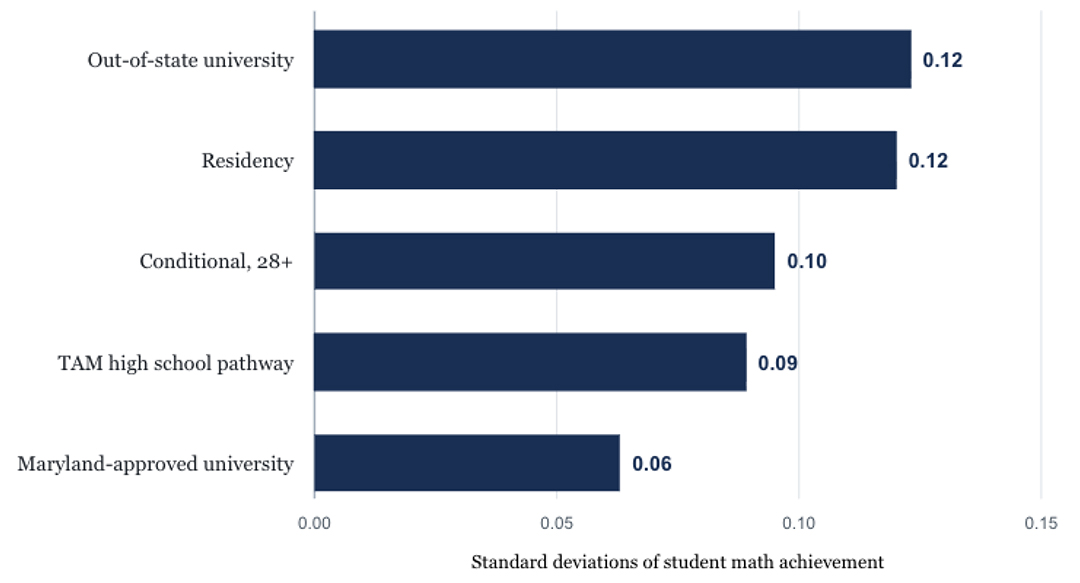
Maryland-approved university programs, the state’s most common route into teaching, were associated with the smallest math gains of any prepared pathway. Out-of-state programs and alternative routes/residencies were associated with gains roughly twice as large.
- Measured across teachers' first two years against young conditionally certified teachers, the ranking runs: out-of-state preparation and alternative routes/residencies at roughly 0.12 standard deviations, conditionally certified teachers age 28 and older at 0.10, TAM completers at 0.09, and Maryland-approved university programs at 0.06.
- Out-of-state traditionally prepared teachers were associated with the highest scores in math, and the authors attribute this to hiring selectivity rather than program quality. Out-of-state candidates converted licenses into Maryland positions at roughly 23% by 2022, while in-state graduates were hired at rates approaching or exceeding the number of new licenses issued. If in-state and out-of-state programs produce graduates of broadly similar quality, that filtering means the out-of-state teachers who get hired are likely drawn from the stronger end of their pool.
*Note: The paper reports no test of whether these pathways differ from each other, only whether each differs from the reference group, so "roughly double" is a comparison of point estimates. Also, TAM is a high school program rather than a licensure route, and its estimate reflects an additional advantage over the license pathway a teacher later completes.
Figure 1: Estimated difference in student math achievement in teachers' first two years, relative to conditionally certified teachers under age 28 at entry
- Conditionally certified teachers age 28 and older outperformed their younger counterparts in math, suggesting that prior professional experience substitutes for training in ways local upbringing does not.
- Local recruitment does not substitute for preparation.
- Young conditionally certified teachers had the deepest local roots of any group, with 66% attending a Maryland public high school and 45% teaching in that same district, compared with 55% and 31% among Maryland-prepared traditionally certified teachers.
- However, every other entry pathway outperformed young conditionally certified teachers in math.
Question 3: Are different dimensions of localness associated with higher retention?
- Growing up locally and training locally were both strongly associated with staying.
- Teachers who returned to their home district were 17 percentage points more likely to remain in that district at five years than teachers who did not attend a Maryland public high school.
- Teachers prepared through Maryland-approved university programs were 11 to 17 percentage points more likely than young conditionally certified teachers to remain in their school, their district, or Maryland public schools at three and five years. Teachers prepared out of state also stayed longer, but their advantage was roughly half as much, at 5 to 7 percentage points.
- Teachers who came up through aide positions were no more likely than other novices to remain in their initial school or district. They were, however, more likely to stay in Maryland public schools.
POLICY AND PRACTICE IMPLICATIONS
- Local roots on their own do not predict teacher effectiveness, which means Grow-Your-Own programs are better judged on the preparation they deliver than on where candidates come from.
- The state's Teacher Academy of Maryland, its approved university programs, and its alternative certification/residency programs were all associated with math advantages over young, conditionally certified teachers. The policy question is less about attracting these candidates than about how they enter the profession once attracted. States in this position can ask what would happen if the same candidates were routed through structured preparation.
- The pathways that produce the strongest achievement are not the ones that produce the strongest retention, so recruitment and retention likely require separate levers.
- Out-of-state preparation and residencies showed the largest math advantages. Their retention advantages were smaller.
- Maryland-approved traditional preparation programs showed the reverse pattern. They carried the smallest math advantage of any prepared pathway, alongside the largest retention advantages.
- The authors argue that achievement should take priority when the two diverge, on the reasoning that ineffective instruction compounds annually while turnover is a one-time disruption. That is their judgment about how to weigh outcomes rather than a finding the data established.
- Aide-to-teacher and alternative certification/residency pathways recruit substantially more diverse candidates who are just as effective as differently prepared teachers, which makes them the clearest candidates for joint diversity and quality investment.
- Teachers who came from aide positions performed at least as well as other novices in math. They were 28% Black compared with 20% of novices overall, and they were more likely to remain in any Maryland K-12 role at five years.
- Alternative certification and residency entrants were 55% white compared with 80% for in-state traditional preparation, and were associated with among the largest math advantages, though they were less likely to remain in Maryland K-12 at five years.
FULL WORKING PAPER
Dominguez-Mel, N., Morris, W. T., Montana, S., & Blazar, D. (2026). Teacher Localness, Early-Career Effectiveness, and Retention. (EdWorkingPaper 26-1501). Annenberg Institute at Brown University. https://doi.org/10.26300/aks6-3197.
The EdWorkingPapers Policy & Practice Series is designed to bridge the gap between academic research and real-world decision-making. Each installment summarizes a newly released EdWorkingPaper and highlights the most actionable insights for policymakers and education leaders. This summary was written by Christina Claiborne.