XunFei Li, Florence Xiaotao Ran, Daman Chhikara, Zachary M. Beamer, Di Xu
Passing gateway math, the first college-level math course a student needs for a degree or transfer, is one of the most important early milestones in community college. Many entering students, however, are underprepared for college-level math and are often placed into remedial math courses that must be completed first and do not count toward a degree. Research has consistently found that these remedial sequences do little to help students complete gateway math, in part because many students drop out before they ever reach the college-level course.
In response, colleges have rapidly adopted corequisite support, a model in which students enroll directly in college-level math and take a paired support course in the same semester that provides “just-in-time” help with the material. The model has spread rapidly: the share of public two-year colleges offering corequisite support grew from 28 percent in 2016 to 77 percent in 2023. Rigorous evidence supports this shift. A randomized trial at the City University of New York found that students assigned to corequisite statistics were 16 percentage points more likely to pass gateway math, and studies of statewide reforms in Tennessee and Texas found that corequisite support increased both enrollment in and completion of gateway math compared with traditional remediation.
Despite the promising evidence of corequisite support, less is known about how these reforms operate in practice when they are scaled up, and this study works to address the following gaps in what is known:
- Most existing evidence comes from tightly controlled experiments or settings with clearly structured course pathways, where students largely take the courses they are placed into. In practice, when colleges have scaled up corequisite support, often only 20 to 50 percent of students referred to it actually enrolled, and little research has asked students, advisors, or instructors why this gap between placement and enrollment occurs.
- Most studies compare corequisite support with prerequisite remediation, and only two have compared it with placing students directly into standalone gateway math. That comparison matters for students near the college-readiness threshold, because corequisite support adds credits, cost, workload, and scheduling complexity that could discourage them from enrolling.
- Relatively little is known about students far below the college-readiness threshold. Many colleges have replaced prerequisite remediation entirely, making it difficult to measure how corequisite support affects these students, and instructors have raised concerns that it may not serve them well.
STUDY AND METHODS
This study examines Virginia’s Direct Enrollment reform at Northern Virginia Community College (NVCC), the largest college in the state system, which began implementing the reform in 2021-22. Before the reform, all students with a GPA below 3.0 were placed into a prerequisite remediation course. After the reform, NVCC started to use a tiered placement model based on students’ self-reported high school GPA: students below a 2.0 are placed in traditional prerequisite remediation, students between 2.0 and 3.0 are placed in gateway math with a paired corequisite support course, and students above a 3.0 are placed directly in standalone gateway math.
Figure 1: The NVCC Tiered Placement Model
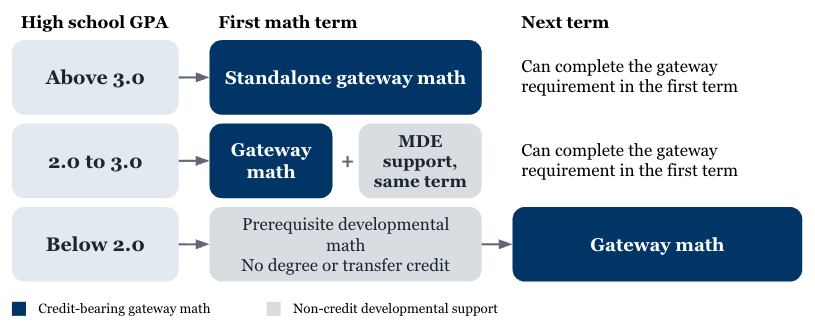
*Gateway math is the first college-level math course required for a student’s program: Precalculus I, Statistical Reasoning, or Quantitative Reasoning, depending on the degree.
This placement model sets which math course students are recommended to take, but students can choose to not enroll in their recommended pathway.
This tiered structure allowed the researchers to compare corequisite support with both alternatives within the same college, for both less-prepared students near the 2.0 cutoff and more-prepared students near the 3.0 cutoff. They paired this analysis with interviews and focus groups with students, advisors, and instructors to explain the patterns they found. The study asks three questions:
- What were students’ math enrollment patterns in their first year after the reform (i.e., how many students took the math course they were recommended to take?)
- What were the effects of placement into corequisite support on gateway math enrollment and completion, compared with prerequisite remediation and with standalone gateway math?
- How do students, advisors, and instructors explain these patterns?
To estimate the effects of corequisite placement, the researchers used a regression discontinuity design, which takes advantage of the GPA cutoffs that determine where students are placed. Students with a high school GPA just below a cutoff are very similar to students just above it, so differences in their outcomes can be attributed to the placement they received. Comparing students on either side of the 2.0 cutoff shows the effect of corequisite placement compared with prerequisite remediation, and comparing students on either side of the 3.0 cutoff shows its effect compared with standalone gateway math.
Note: Because students’ actual enrollment was partly their own choice, the researchers estimated the effect of being placed into corequisite support by comparing students just above and just below each GPA cutoff, regardless of what they actually took, and this effect likely differs from the effect of actually taking the corequisite support class.
KEY FINDINGS
RQ1: What were students’ math enrollment patterns in their first year after the reform?
- About 40 percent of students did not enroll in their recommended math course, and 30 percent took no math at all, including remedial math.
- First-year enrollment in college-level (gateway) math was lower for cohorts after the reform than for earlier NVCC cohorts. Interview findings described below point to likely reasons for low enrollment under the reform.
RQ2: What were the effects of placement into corequisite support on gateway math enrollment and completion, compared with prerequisite remediation and with standalone gateway math?
- Students placed into corequisite support instead of prerequisite remediation were more likely to enroll in gateway math in their first year than similar students placed into prerequisite remediation.
- Students just above the 2.0 cutoff, who were placed in corequisite support over prerequisite support, were 35 percentage points more likely to enroll in gateway math within their first year than students just below the 2.0 GPA cutoff, who therefore placed into prerequisite remediation. The main implication is that, for students with weaker academic preparation, corequisite placement removes the delay that comes from traditional remediation and gets far more of them into college-level math in their first year.
- Students placed into corequisite support instead of prerequisite remediation were also more likely to complete gateway math in their first year than similar students placed into prerequisite remediation, though completion gains were about half as large as enrollment gains.
- Students placed into corequisite support were 17 percentage points more likely to complete gateway math than students placed into prerequisite remediation. 17 percentage points is about half the enrollment gain of 35 percentage points, so many students who reached gateway math through corequisite placement did not pass.
- Students placed into corequisite support instead of standalone gateway math were less likely to enroll in gateway math than similar students placed directly into standalone gateway math.
- Students just below the 3.0 GPA cutoff, who were placed in corequisite support over direct gateway math were 12 percentage points less likely to enroll in gateway math within their first year than students just above the 3.0 GPA cutoff, who were placed in gateway math without a support course. The main implication is that, for students who are close to being ready for college-level math, placing them in a corequisite support course can discourage or delay enrollment in gateway math.
- Among students near the 3.0 GPA cutoff who enrolled in gateway math, students placed into corequisite support passed at higher rates than students placed into standalone gateway math.
- Among students who did enroll in gateway math, those placed into corequisite support completed at a rate 14 percentage points higher than those placed into standalone gateway math. This comparison is not causal, because students who chose to enroll may differ from those who did not, but it suggests the support helped those who took it.
RQ3: How do students, advisors, and instructors explain these patterns?
- Gaps in information and advising led many students to delay math.
- Students were not required to meet with an advisor before registering, and many did not understand the importance of taking math in their first year, how math courses are sequenced, or what transfer institutions require. Some assumed high school math would satisfy college requirements.
- The placement survey and college website offered little explanation of what the corequisite course was, so some students learned about it only when registration blocked them from enrolling in gateway math alone.
- The extra cost and registration steps of corequisite support discouraged enrollment.
- Students had to register for matched pairs of gateway and support sections, where a mismatch triggered an error that could lead students to give up and register for something else. Students below a 3.0 were also assigned a corequisite English course, compounding the added load.
- The design of the support course and wide differences in students’ preparation limited its benefits.
- Because the support course did not count toward students’ GPA or affect their grade in the gateway course, students had little incentive to engage.
- With no placement test, student skill level varied widely, and instructors spent early weeks reteaching basic skills, leaving less time for support tied to the gateway course content and may have disengaged better-prepared students. Students just below 3.0 were often among the strongest in their corequisite class, limiting their exposure to more college-ready peers.
POLICY AND PRACTICE IMPLICATIONS
Expanding access to college-level math is not enough on its own to improve outcomes for students. Whether corequisite reform pays off depends on whether students actually enroll in the courses they are placed into and whether the support they receive fits their needs.
The authors provide recommendations that fall into three areas:
- More proactive advising about math course sequences, transfer requirements, and the importance of completing gateway math early could increase math course enrollment.
- One option they highlight is pairing mandatory advising with orientation, so that students who would not seek out an advisor on their own still get clear direction about math and English enrollment in their first semester. They point to community colleges that have used this approach and seen improved first-year course completion. The findings also suggest colleges should explain what corequisite support is and why students are assigned to it, since students reported learning about the course only when registration blocked them or through sites like Rate My Professors.
- Reducing the financial and logistical barriers that come with corequisite support is also likely to increase math course enrollment.
- Corequisite placement added costs and registration steps, and these burdens appeared to discourage enrollment, especially among students near the 3.0 cutoff. The authors suggest colleges consider tuition waivers or dedicated aid for corequisite courses, make sure those courses align with financial aid eligibility rules, and simplify registration so that students enroll in paired gateway and support sections together without running into errors. More structured advising could also help students see how the support course fits into their academic plans instead of viewing it as an extra hurdle.
- Corequisite support may work better when matched to students’ preparation. Less-prepared students may need more intensive help, while students near college readiness may be better served by lower commitment support.
- For less prepared students (students with a high school GPA near 2.0), students placed in corequisite placement were more likely to enroll in gateway math by 35 percentage points, but were only 17 percentage points more likely to complete gateway math, compared to students placed in prerequisite remediation. This suggests less prepared students in corequisite placement need more help within the course to pass. The authors recommend adding support within corequisite courses, such as embedded tutors.
- For students with a high school GPA near 3.0, corequisite placement reduced gateway math enrollment by 12 percentage points compared with standalone gateway math, likely because the required support course added three credits, extra cost, and scheduling constraints. The authors suggest offering these students optional, lower-commitment support, such as targeted workshops or supplemental instruction, so they can enroll in gateway math without taking on a full additional course.
FULL WORKING PAPER
Li, X., Ran, F. X., Chhikara, D., Beamer, Z. M., & Xu, D. (2026). The Access–Enrollment Disconnect in Corequisite Math Reform: Causal Evidence and Stakeholder Perspectives from a Community College. (EdWorkingPaper: 26-1577). Retrieved from Annenberg Institute at Brown University: https://doi.org/10.26300/8cq3-a502
The EdWorkingPapers Policy & Practice Series is designed to bridge the gap between academic research and real-world decision-making. Each installment summarizes a newly released EdWorkingPaper and highlights the most actionable insights for policymakers and education leaders. This summary was written by Christina Claiborne.