Douglas N. Harris, Gabriel Olivier
The rapid spread of universal private school vouchers marks one of the most significant shifts in U.S. education policy in decades. As states increasingly adopt universal voucher programs, what will this mean for access, affordability, and the future of public education?
What are school vouchers and why do they matter?
School vouchers are publicly funded grants that allow families to put a set amount of state dollars toward covering the costs of private school tuition instead of attending a public school. Originally designed to expand options for low-income families, many states now offer universal voucher programs that make nearly all students eligible to receive publicly funded dollars to cover private school tuition, regardless of income, local school quality, or prior private school attendance.
This rapid expansion has made vouchers one of the most politically contentious policies in American education. Supporters argue that vouchers increase competition and create opportunities for students who might otherwise be unable to afford private schooling. Opponents counter that spending taxpayer dollars on private schooling undermines core traditions of American public education, including public governance and the separation of church and state. They also warn that vouchers siphon resources from already underfunded public schools, exacerbate existing inequities by primarily benefiting families who were already in private schools, and reduce accountability since private schools are not subject to the same transparency or oversight as public schools.
How has the policy landscape of school vouchers changed over time?
For decades, voucher programs were usually limited in scope, typically targeting low-income families, urban students, or children attending low-performing schools. Some of these programs also included some rules, such as requiring students to take state tests. Since 2021, however, the landscape has shifted dramatically due to a convergence of parental demand driven by the COVID-19 pandemic, favorable political momentum, and legal rulings that cleared the way for widespread adoption of universal voucher programs. By the time of this study, 17 states had enacted broad-access models.
The findings in this study are especially salient in light of the recent passage of the One Big Beautiful Bill Act, which is set to take effect on January 1, 2027. If implemented as intended, the program would effectively function as a nationwide voucher, allowing all states to opt in to federal funding for private-school choice.
As states adopt universal programs at scale, the stakes are high: how these policies reshape enrollment patterns, school finances, and access to quality education will have long-term consequences for students, families, and the public education system as a whole.
Before examining the effects of voucher policies, it’s helpful to understand what the private school sector actually looks like today. Figure 1 shows that the majority of U.S. private schools are religiously affiliated, while nonreligious schools make up a smaller share.
Figure 1: Distribution of U.S. Private Schools by Type
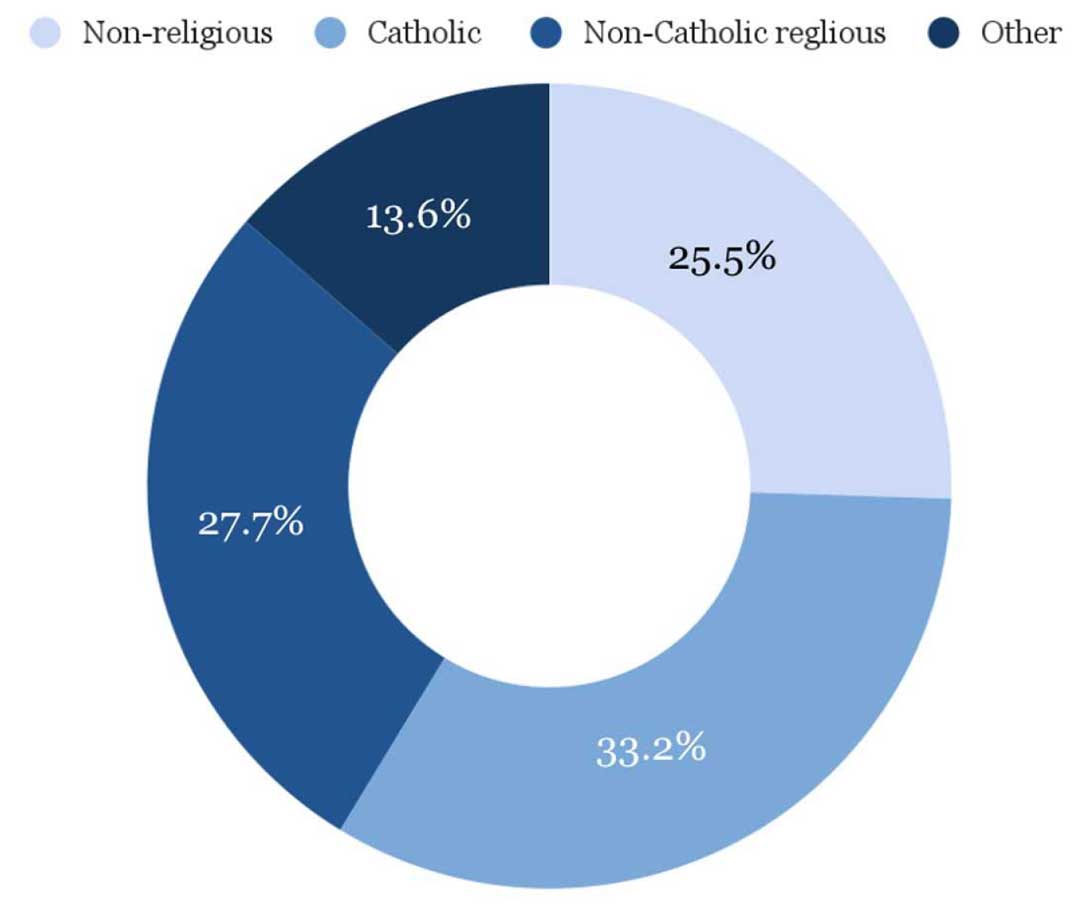
Data Source: U.S. Department of Education, National Center for Education Statistics, 2021
STUDY AND METHODS
This study uses a difference-in-differences design to examine the short-run effects of universal school voucher programs on private school enrollment and tuition nationwide. The authors compared trends in 11 states that adopted vouchers between 2021 and 2024 with 34 states that did not, allowing them to see whether private schools in voucher states grew faster or raised tuition more. By tracking changes before and after program adoption, the study isolates the policy’s impact from national trends in private school enrollments and tuition that impact all states in the same way, offering some of the first systematic national evidence on how private schools respond to universal vouchers. The study is also the first to put together a national dataset on private school enrollment, tuition, and financial aid.
KEY FINDINGS
- Private schools vary in size and tuition. Most are small, religiously affiliated, and less costly than the “elite prep school” stereotype.
- At one end are small schools, often religiously affiliated, that charge a few thousand dollars per year. At the other extreme are elite boarding schools that enroll hundreds of students and charge more than $150,000 annually. The most common (modal) private school serves about 30 students with an annual tuition of around $5,000.
- Private school enrollment in voucher states has increased by about 3–4% (about 35,000 additional students) relative to non-voucher states, on average.
- Since private schools still serve only a small fraction of U.S. students (about 10%), 3-4% growth doesn’t fundamentally shift the sector.
- The largest enrollment increases were in smaller schools and in non-Catholic religious schools with a median tuition of $7,000. This suggests that those switching from public to private schools were probably choosing schools that were already more affordable before the voucher policy.
- Over 90% of vouchers are being used by families whose children already attend private schools.
- While private school enrollment only grew by about 35,000 students, more than 500,000 students nationwide received vouchers. That means most voucher recipients were already in private schools rather than new switchers from public schools, and families are essentially using vouchers to get a taxpayer-funded discount on their private school tuition.
- In states that expanded voucher access, private school tuition increased by 5–10% more than in states without voucher programs. The largest increases in tuition occurred in non-religious schools, schools that previously charged lower tuition, or served fewer students.
- This suggests that smaller, lower-cost schools responded to the influx of new voucher dollars by raising tuition, which may limit the access gains vouchers are designed to create for low- and middle-income families.
- Meanwhile, high-tuition or elite schools showed less change, possibly because their prices were already beyond the reach of most voucher families.
- The authors theorize that religious schools are less likely to raise tuition because their goals extend beyond maximizing revenue. Many religious schools may view enrollment as a way to boost broader religious participation and donations, and may view raising tuition in response to voucher programs as antithetical to their schools’ charitable mission.
Although this study's short-run effects on enrollment and tuition are modest, the authors argue that the longer-term impacts may be larger as families and schools adjust to the new policy environment.
The authors expect the short-run effects found in this paper to be smaller than the long-run effects for seven reasons:
- Information gaps: Families may not yet know about the new programs.
- Application lags: Parents often make school decisions before policies launch, so timing dampens immediate effects.
- Capacity limits: Many private schools are already near capacity.
- Supply response takes time: Schools need time to hire staff, add classrooms, or even open new schools to accommodate to new demand.
- Cultural and social inertia: For families who are accustomed to public schooling, switching sectors is a big decision that doesn’t happen overnight.
- Financial adjustment: Some families may need time to plan around the additional costs that vouchers don’t cover, which can still be substantial.
- Policy uncertainty: Some families and schools may wait to see if funding is stable before making big moves.
Note: Universal voucher rollouts coincided with the COVID-19 pandemic, when schools faced rising costs for staffing, safety, and technology, along with broader inflation and higher private school demand. This overlap makes it difficult to separate tuition hikes caused by vouchers from those driven by pandemic pressures. The authors caution that while vouchers are clearly linked to higher tuition, some of the effect may reflect pandemic-era dynamics rather than the policy alone.
IMPLICATIONS FOR POLICY AND PRACTICE
Require participating private schools to report enrollment, student outcomes, demographic breakdowns, and financial data. This allows stakeholders to assess quality and ensures accountability for public investment.
Monitor whether vouchers are expanding access for new students or primarily subsidizing existing private school enrollment. States should closely track new vs. existing private school users. This will help assess whether vouchers are expanding access or simply subsidizing existing choices.
If public schools lose students (and the funding tied to them) as voucher programs grow, states should look for ways to stabilize public education systems, especially in under-resourced communities, so they aren’t left with fewer resources to serve the students who remain. States can guarantee minimum funding levels for districts, even if student enrollment declines modestly due to vouchers. “Hold harmless” provisions or multi-year funding averages can help public schools adjust more gradually.
Pair voucher expansion with pricing safeguards or accountability measures to ensure that access and equity goals are preserved. Expanding voucher access without mechanisms to monitor or cap tuition increases may unintentionally undermine affordability for the very families vouchers are designed to serve.
FULL WORKING PAPER
This report is based on the EdWorkingPaper “The Effects of Universal School Vouchers on Private School Tuition and Enrollment: A National Analysis,” published in September 2025. The full research paper can be found here: https://edworkingpapers.com/ai25-1293.
The EdWorkingPapers Policy & Practice Series is designed to bridge the gap between academic research and real-world decision-making. Each installment summarizes a newly released EdWorkingPaper and highlights the most actionable insights for policymakers and education leaders. This summary was written by Christina Claiborne.