Jenna Howard Terrell, Joanna Rometsch Mathias, Diana Roldan-Rueda, and Alyssa Blanchard
Dual enrollment (DE) has expanded rapidly over the past decade as a strategy for extending college-level coursework to students who have historically been underrepresented in advanced academic tracks. California's College and Career Access Pathways Act of 2016 made that goal explicit, bringing community college courses onto high school campuses and removing many prerequisite barriers to participation.
As participation has widened, so has the range of academic preparation and institutional support that students bring into these courses. That shift has raised the question: when access expands, who fails, and what does failure cost?
The existing research on dual enrollment compares participants to non-participants and reports average benefits, which tells us little about the students who enroll and do not succeed. Few studies have looked directly at failure itself, in part because dual enrollment pass rates are generally high in programs that admit only students screened as college-ready.
This distinction matters because it points to different responses. Districts and states have two main levers: they can limit who gets into DE, or they can invest in helping enrolled students succeed. Which lever fits depends on where the inequity actually sits.
If disadvantaged students both fail more often and pay a higher price when they do, open access would then be handing the most vulnerable students a double penalty, and tighter eligibility rules would have a real justification. If instead these students fail more often but face the same consequences as everyone else when it happens, the problem would then be located in what happens after enrollment, and screening students out would address the wrong thing. This study tests both possibilities using statewide administrative data.
STUDY AND METHODS
This study uses California state administrative records for roughly 1.74 million students who started 9th grade between 2015-16 and 2018-19. College enrollment data comes from National Student Clearinghouse data and counts enrollment at any college or university within 18 months of high school completion.
A student counts as a DE participant if they took at least one DE course in high school, and as having failed if they received a failing grade in at least one of those courses. Prior preparation is measured by 8th-grade math scores, which are available for nearly every student and come from before high school, so they cannot have been affected by the DE experience itself. Socioeconomic disadvantage follows the state definition, which covers students eligible for free or reduced-price lunch and students whose parents did not complete high school.
Three questions organize the study, each built on a different comparison:
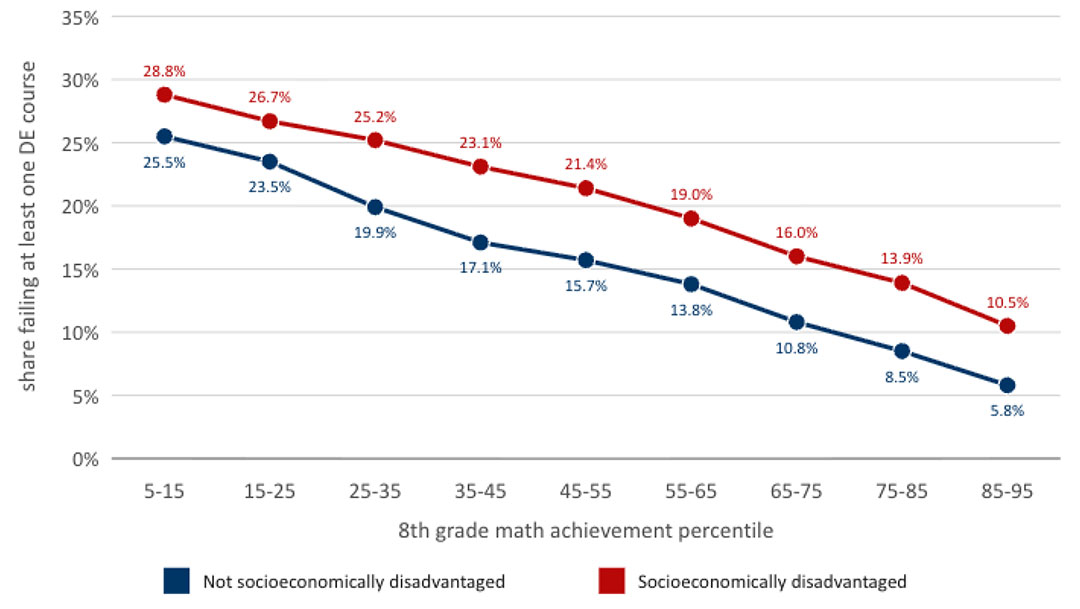
- Who is most likely to fail? They analyze failure rates across the full range of 8th-grade math scores, separately for students who are and are not socioeconomically disadvantaged.
- What happens to students who fail, compared with those who pass? They compare students who failed a dual enrollment course to students who took dual enrollment and passed, adjusting the comparison so the two groups look alike on race and ethnicity, disadvantage status, prior achievement, number of dual enrollment courses taken, and cohort.
- Are students better off having tried and failed than not having tried at all? They compare students who took dual enrollment and failed to similar students who never took a dual enrollment course, pairing each student who failed with a matched non-participant. Both groups are limited to students who never took an AP course, since the question here concerns students for whom dual enrollment was the only route into college-level work.
Comparisons are made within school district to control for differences across districts, so students are effectively compared only to others in their own district rather than across districts with different programs.
The authors compare students who look alike on key measures (race, socioeconomic status, 8th grade math achievement, DE participation, and cohort) and they check the quality of those comparisons against What Works Clearinghouse standards. Students who take dual enrollment and students who fail it may still differ in ways administrative data cannot see, including motivation and family circumstances, so the results are best read as well-supported patterns rather than causal estimates.
KEY FINDINGS
Socioeconomically disadvantaged students failed DE courses at higher rates than their peers at every level of prior achievement, and the gap grew wider among higher-achieving students.
- Overall, 17.1% of dual enrollment participants received a failing grade in at least one course.
- Among students in the lowest achievement band (5th to 15th percentile in 8th grade math), disadvantaged students failed at 28.8% compared with 25.5% for non-disadvantaged students, a gap of 3.3 percentage points. Among students in the highest band (85th to 95th percentile), the rates were 10.5% and 5.8%
- The authors term this pattern the preparation paradox. The authors point toward non-academic factors including navigational resources, financial pressure, belonging, and access to support infrastructure, but these explanations are not tested directly.
Figure 1: Share of dual enrollment participants failing at least one course, by 8th grade math percentile
- Students who failed a DE course were less likely to enroll in college compared with similar students who took DE and passed.
- Failing DE was associated with a 12.2 percentage point lower likelihood of enrolling in college compared to students who took DE and passed. This estimate compares students who arrived at dual enrollment with the same prior achievement, demographics, disadvantage status, and course load, so the 12.2 percentage points is associated with failing itself, not pre-existing differences among students.
- The study cannot identify why this happens. Possible mechanisms include: 1. A failing grade creates transcript and eligibility damage that makes it harder to enroll in college. 2. Failing creates a psychological effect: a student who was told that dual enrollment is a preview of college, and who then fails, may reasonably conclude that college is not for them. 3. Either or both 1 and 2 could impact subsequent high-school course-taking patterns to less rigorous coursework, lowering preparation and reinforcing the patterns in 1 and 2.
- Among students for whom DE was the only accessible advanced coursework, those who enrolled in DE and failed were still more likely to enroll in college than comparable students who never enrolled in DE.
- The authors estimate that students who enroll in DE and fail are 6.4 percentage points more likely to enroll in college than students who never enrolled in DE, based on 10,750 matched pairs of students who never took AP.
- The advantage is similar in size for non-disadvantaged students and disadvantaged students.
POLICY AND PRACTICE IMPLICATIONS
- Raising eligibility thresholds is unlikely to close the failure gap between advantaged and disadvantaged students, because the gap is widest among higher-performing students.
- Disadvantaged students at the 90th percentile in 8th-grade math still failed at a rate well above that of their similarly prepared peers.
- Screening on prior achievement would exclude large numbers of students who would have passed. In the lowest achievement band, roughly 7 in 10 disadvantaged students who enrolled completed their dual enrollment courses without failing.
- Prior work has found that districts replacing placement tests with grade-based eligibility increased participation without a corresponding drop in pass rates, which suggests current definitions of college readiness are set more conservatively than the evidence requires.
- Disadvantaged students who arrive to DE academically prepared are the group the current system serves least well, so supports that address non-academic conditions for these students could be particularly impactful.
- The study does not test specific supports, but interventions identified in other DE studies include proactive advising, early alert and outreach when students begin to struggle, help with the logistics of enrolling and navigating a college system, coordination between high school and college staff, and attention to transportation and scheduling barriers.
- The evidence supports open access and stronger support at the same time: attempting DE helped students even when they failed, but failing still cost them substantially relative to passing.
- For students whose only route into college-level coursework was dual enrollment, those who enrolled and failed were 6.4 percentage points more likely to enroll in college than matched students who never enrolled at all. Restricting access would remove that advantage from students who would have failed and from the far larger share who would have passed.
- A district-wide failure rate can look stable while masking a widening gap among its best-prepared students. Disaggregating by group within achievement bands makes that gap visible.
- An aggregate failure rate blends two different things: which students enroll and how likely each group is to fail. Districts that disaggregate by prior achievement will be able to see whether prepared students are failing at different rates across groups, which is the pattern that points toward support gaps rather than preparation gaps.
- The study identifies who is failing but not why. Districts can investigate locally why academically prepared students are failing, which would inform how to support students.
- Districts have access to evidence the state data cannot supply. Asking students who enrolled and struggled what got in the way, and checking whether failures cluster in particular courses, terms, campuses, or college partners, would identify local causes.
FULL WORKING PAPER
This report is based on the EdWorkingPaper "Course Failure in Dual Enrollment and the Impact on College-Going," published in July 2026. The full research paper can be found here: https://doi.org/10.26300/68e0-sh41.
The EdWorkingPapers Policy & Practice Series is designed to bridge the gap between academic research and real-world decision-making. Each installment summarizes a newly released EdWorkingPaper and highlights the most actionable insights for policymakers and education leaders. This summary was written by Christina Claiborne.